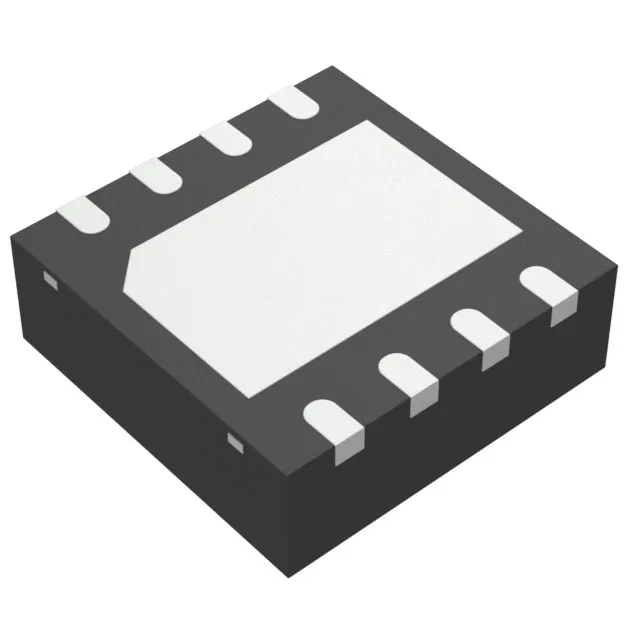
28 V boost in a 3 mm × 3 mm SON
The TPS61045ADRBR is a step-up (boost) DC-DC converter from Texas Instruments that takes a 1.8 V to 6 V input and delivers an adjustable output up to 28 V. The 300 mA integrated switch and 1 MHz switching frequency let you build a compact supply for bias rails, OLED panels, or small-signal high-voltage needs without an external FET.
Input range and battery compatibility
The 1.8 V minimum input covers a single-cell Li-ion battery from nearly full discharge (around 3.0 V) down to the protection cutoff. The 6 V maximum input also handles 2S alkaline or USB 5 V rails without a pre-regulator. For a 3.7 V Li-ion cell, the output can be set anywhere from 1.8 V to 28 V, making it suitable for generating a 12 V or 24 V bias rail from a single cell.
Switch current and output power budget
The 300 mA switch current limit sets the maximum output power. At 28 V output from a 3.3 V input, the achievable load current is roughly 60 mA, assuming 80 % efficiency. This is enough for small-signal bias rails, op-amp supplies, or OLED bias — not for high-current loads. The actual output current scales inversely with the output-to-input voltage ratio.
Switching frequency and component size
Switching at up to 1 MHz allows the use of small inductors (typically 4.7 µH to 22 µH) and ceramic capacitors, keeping the total solution footprint small. The 8-SON (3 mm × 3 mm) package itself is compact, and the high switching frequency means the external components also stay small — a good fit for space-constrained battery-powered designs.