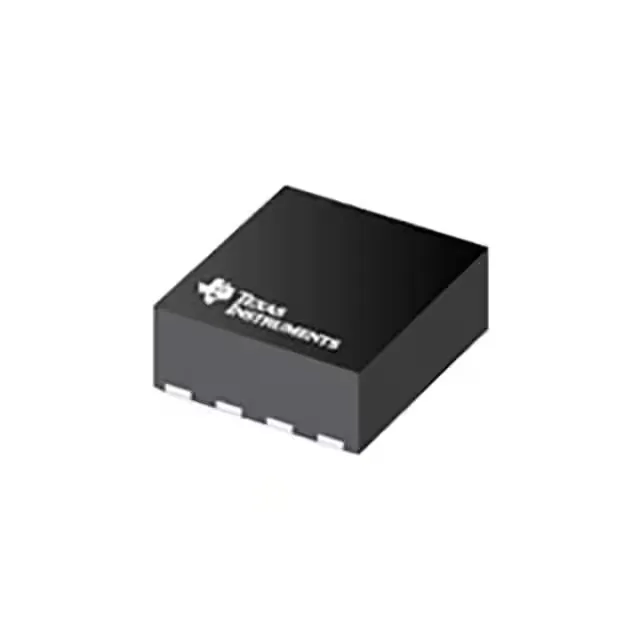
8 A boost in a 2x2 mm footprint
The Texas Instruments TPS61022RWUT is a synchronous step-up (boost) DC/DC converter delivering up to 8 A from a single-cell battery input as low as 0.5 V. The adjustable output range spans 2.2 V to 5.5 V, making it suited for USB OTG, portable speakers, and Li-ion battery-powered equipment where the rail must stay regulated as the cell drops below 3 V. The 7-VQFN-HR (2x2 mm) package packs the 8 A switch into a board area that fits alongside a 1210 inductor on a compact layout.
Switching frequency trade-off
The switching frequency is pin-selectable between 600 kHz and 1 MHz. At 600 kHz the efficiency peaks at higher step-up ratios (e.g., 3.3 V from a near-depleted Li-ion cell), but the inductor needs a larger value — typically 2.2 µH to 4.7 µH. At 1 MHz the inductor shrinks to 1 µH or even 0.47 µH, which reduces the BOM height and footprint at the cost of slightly higher switching losses. The synchronous rectifier recovers some of that loss by replacing the Schottky diode with a low-Rds(on) FET.
Thermal and layout reality
Delivering 8 A from a 2x2 mm package demands a thermal design that treats the exposed pad as the primary heat path. The supply input range (0.5 V min, 5.5 V max) means the part can start from a deeply discharged battery, but the input ripple at full load needs low-ESR ceramic caps on both input and output.