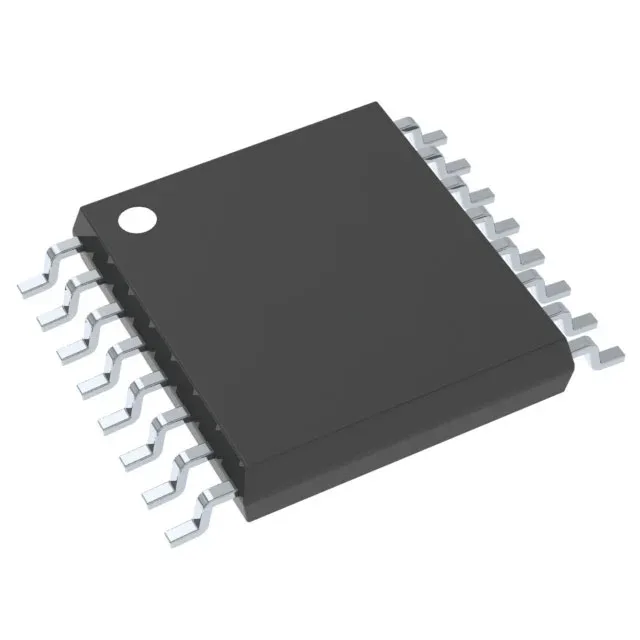
Step-down controller for intermediate-rail and point-of-load designs
The Texas Instruments TPS40195PWR is a single-phase synchronous buck PWM controller designed for step-down conversion from input rails spanning 4.5 V to 20 V. It drives an external transistor pair (high-side and low-side) and integrates features such as current limit, enable, frequency control, power-good flag, and soft-start. The device supports external clock synchronization, allowing multiple converters to run at a common switching frequency for cleaner EMI management or interleaved operation. Housed in a 16-TSSOP package (4.40 mm width), it is rated for operation over -40°C to 125°C junction temperature, making it suitable for industrial, telecom, and automotive under-hood environments where the controller itself may see elevated ambient temperatures.
Switching frequency and inductor sizing flexibility
Lower frequencies reduce switching losses and improve efficiency at light loads but require larger magnetics; higher frequencies shrink the inductor footprint at the cost of increased gate-drive and core losses. The 85% maximum duty cycle supports step-down ratios down to about 1.2 V output from a 5 V rail, or higher ratios from 12 V intermediate buses, given the controller's 4.5 V minimum input.
Synchronous rectification and control features
The TPS40195PWR includes synchronous rectification, which improves efficiency by replacing the freewheeling Schottky diode with a low-RDS(on) MOSFET. The controller provides a transistor-driver output that directly drives the external MOSFET pair. Built-in control features — current limit, enable, power-good flag, and soft-start — simplify sequencing, fault handling, and startup ramp control without external supervisor ICs.