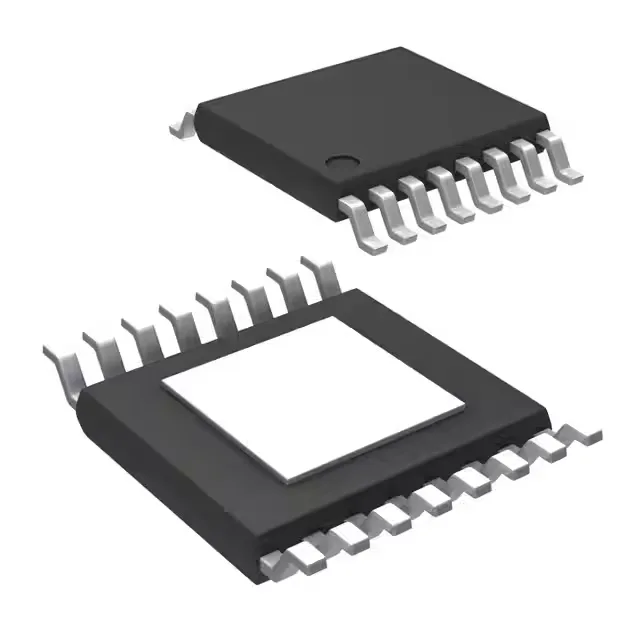
10V to 40V input, synchronous buck control
The TPS40056PWP is a voltage-mode synchronous buck controller from Texas Instruments, designed to regulate outputs from a 10V to 40V supply rail — the wide input range covers 12V, 24V, and 36V intermediate buses common in industrial control and telecom equipment. Switching frequency is programmable from 100kHz to 1MHz via a single resistor on the RT pin, letting the designer trade inductor size against switching losses. The 90% maximum duty cycle supports low-dropout operation when the input rail sags close to the target output voltage.
Synchronous rectification and control features
Built-in synchronous rectification drives external N-channel MOSFETs on both the high-side and low-side, eliminating the Schottky catch diode and improving efficiency at low output voltages — a common requirement for 3.3V and 5V rails derived from a 24V bus. The controller integrates current limiting, soft-start, enable, and frequency control, reducing the external component count to a handful of passives and FETs. The soft-start pin programs the output ramp time with a single capacitor, preventing inrush current at power-up. Clock synchronization allows the TPS40056PWP to lock to an external oscillator, enabling multi-phase interleaved designs that cancel input ripple current — useful when multiple rails share a common input filter.
16-HTSSOP PowerPAD thermal management
The datasheet layout recommendation (page 7) shows a 4.4mm x 3.4mm pad with thermal vias to the ground plane — nominal is not absolute max, but the pad area directly sets the junction-to-ambient thermal resistance. The controller itself does not carry the switching FETs, so the thermal budget is dominated by the external MOSFETs and inductor.
The part is RoHS3 compliant (lead-free) and supplied in tubes of 90 pieces per the standard TI shipping quantity. For new designs, the part is suitable for production.