What the automotive grade and AEC-Q100 mean for the BOM
The TPS25940AQRVCRQ1 carries an Automotive grade designation and is qualified to AEC-Q100, the stress-test qualification standard for automotive ICs. This means the part has passed the full suite of reliability screens — temperature cycling, ESD, latch-up, and extended high-temperature operating life — at the -40°C to +125°C junction temperature range. For a power-management IC sitting on an engine-control unit or a transmission controller that sees 105°C ambient, the 125°C TJ rating provides the headroom needed to avoid derating the load current.
Electronic fuse function — what the 5.3 A and 2.7-18 V input actually protect
This is an electronic fuse, not a current-sense amplifier or a hot-swap controller. It integrates a power switch and a current-limiting loop that holds the output current to 5.3 A typical with ±8% accuracy. The 2.7 V to 18 V input range covers the common automotive rails — a 12 V battery that dips to 4.5 V during cold crank and rises to 16 V during a load dump still stays inside the operating envelope. The ±8% accuracy on the current limit means the designer budgets for a 5.7 A worst-case trip threshold, not the nominal 5.3 A.
Package and board integration — 20-WQFN with exposed pad
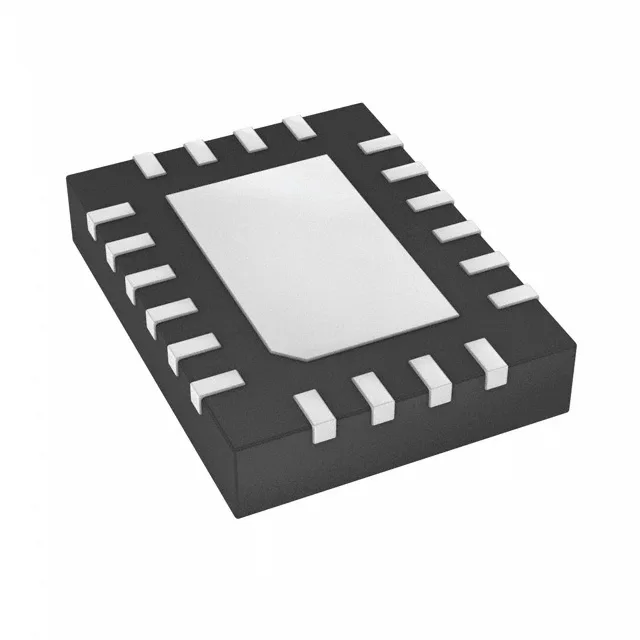
The 20-WQFN (4x3 mm) package with an exposed thermal pad requires a PCB land pattern that ties the pad to a copper plane for heat spreading. The supplier device package is 20-WQFN (4x3), and the package / case is 20-WFQFN Exposed Pad. Surface-mount assembly with a standard lead-free reflow profile works; the exposed pad must be soldered, not just tacked with adhesive, to achieve the rated thermal performance.