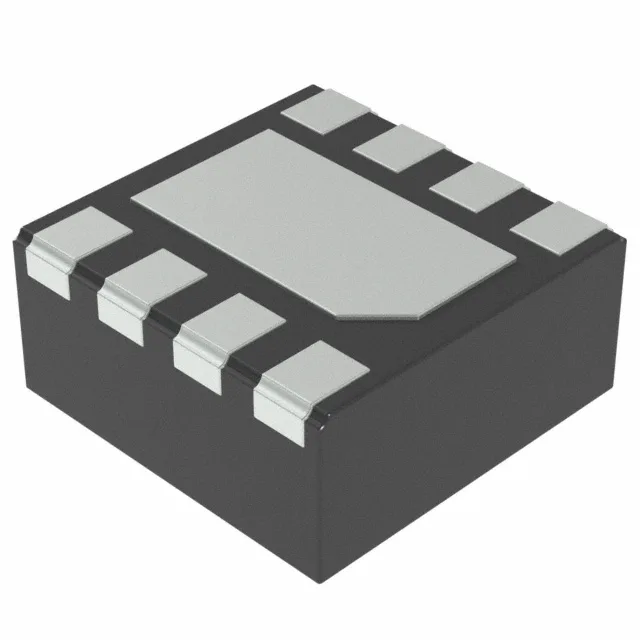
Automotive load switch — 16 mOhm pass FET with bias-rail flexibility
This decoupling lets a low-voltage GPIO from a 1.8 V microcontroller or an always-on 3.3 V rail control the switch independently of the load voltage. Rated for continuous output current up to 4 A, the 16 mOhm Rds(on) produces a conduction loss of about 64 mW at full load — well within the thermal budget of the 8-WSON package when the exposed pad is soldered to a suitable copper plane.
Slew-rate control and load discharge — why they matter for the bus
The slew-rate controlled turn-on ramps the output voltage over a fixed internal interval, limiting the inrush current that charges the downstream bulk capacitance. Without this feature, a 10 µF capacitor bank at 5 V would draw a current spike limited only by the FET's saturation current and the supply impedance — easily exceeding the 4 A rating and tripping the upstream supply. When the switch is disabled, the integrated load-discharge FET pulls the output node to ground through a pull-down resistor. This prevents the output from floating at an indeterminate voltage on a shared power bus — a common failure mode in multi-rail systems where one rail collapses while another remains up. The switch is non-inverting and uses a simple On/Off interface — a logic-high on the enable pin turns the FET on.
8-WSON with wettable flank — AOI-ready for automotive assembly
These side pads wick solder during reflow, creating a visible fillet that automated optical inspection (AOI) systems can verify — a requirement for zero-defect programs in automotive electronics manufacturing. Surface-mount assembly with wettable flanks eliminates the need for X-ray inspection of the hidden solder joints under the package.
Sourced through independent distribution channels.