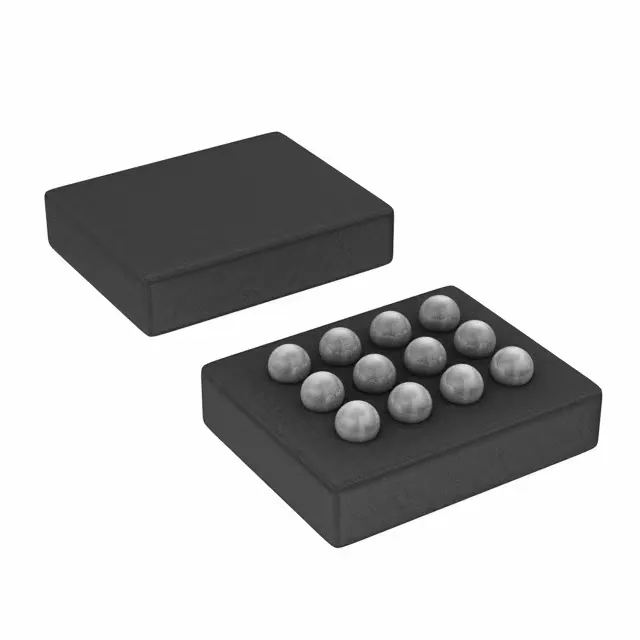
The Texas Instruments TPD4S214YFFR is a single-chip USB OTG protection solution built around an internal switch. It is designed to handle the overvoltage, overcurrent, and reverse-current conditions that occur when a USB On-The-Go port is connected to an out-of-spec or faulty accessory. The part is packaged in a 12-DSBGA (12-UFBGA) — a 0.4 mm pitch wafer-level chip-scale package. That footprint is tiny, roughly 1.6 mm × 1.6 mm, which suits space-constrained portable designs like smartphones, tablets, and handheld instruments where the USB connector is the only external I/O. The 12 balls carry the VBUS, VBAT, and control lines for the OTG path.
The 12-DSBGA package is a lead-free, RoHS-compliant wafer-level chip-scale package (WLCSP). It requires a surface-mount assembly process with a stencil aperture matched to the 0.4 mm ball pitch. The solder balls are SnAgCu (SAC) alloy, reflowed per the standard JEDEC profile for lead-free assemblies. The small package body means the board-level solder joint reliability depends on the PCB pad design — a solder-mask-defined pad (SMD) is typical for this package to control the ball contact area.
Sourcing posture for the BOM line
No stock-holding claim is made; the part is procured per the buyer's quantity and delivery schedule.