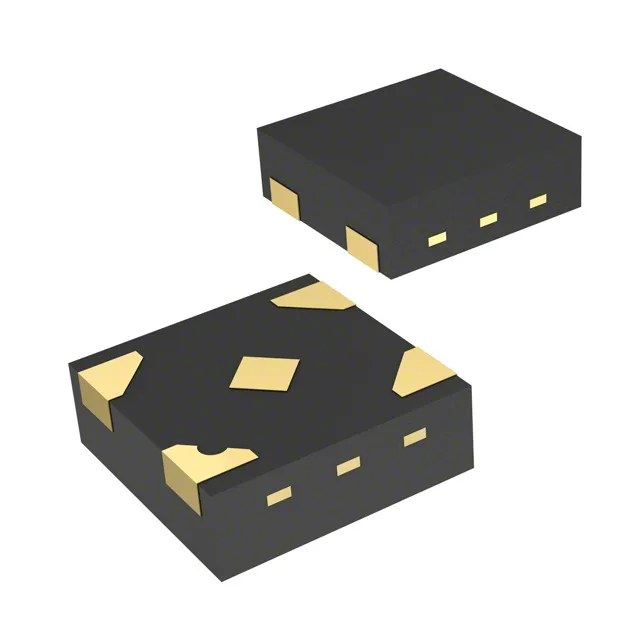
The Texas Instruments TPD4E110DPWR is a four-channel steering (rail-to-rail) ESD protection diode array, purpose-built to guard high-speed differential data lines like HDMI against electrostatic discharge events. Each of the four unidirectional channels shunts a transient to the supply rail or ground, clamping the voltage at a typical 13V during a 5A peak pulse (8/20µs waveform). The reverse standoff voltage is rated at 5.5V max, and the breakdown minimum is 6.5V, so it sits comfortably on a 3.3V or 5V HDMI supply without conducting during normal operation. It comes in a 4-X2SON package measuring just 0.8x0.8mm — a tiny footprint that fits directly on the HDMI connector pins or near the port on a compact PCB.
When you see 'Applications: HDMI' in the spec, it means the diode capacitance and clamping speed are characterised for multi-gigabit differential pairs. The 5A peak pulse rating (8/20µs) covers the typical IEC 61000-4-2 level 4 contact discharge (8kV) without the part breaking a sweat. The 35W peak pulse power handling (8/20µs) is modest — this is a signal-line protector, not a mains surge suppressor. On a board that sees repeated high-energy transients (like long unshielded HDMI cables in an industrial display), you might want to add a TVS with higher energy rating upstream. For a consumer HDMI port inside a metal enclosure, the TPD4E110DPWR is the right call.
The supplier device package is 4-X2SON (0.8x0.8mm) — that's the body size, not the pad pitch. The exposed pad underneath (4-XFDFN Exposed Pad case style) must be soldered to the ground plane for thermal and electrical performance. A hot-air rework station with a fine nozzle can handle this; just pre-bake the tape if the reel has been open past the MSL floor life. Mounting is surface mount only (no through-hole variant).
That means no last-time-buy scramble, no forced redesign for a replacement.