What this rail-clamp array does that a plain TVS diode can't
The TPD4E001DCKR is a four-channel steering (rail-to-rail) ESD protection array from Texas Instruments. Instead of a single zener or TVS diode per line, it uses steering diodes to shunt transients to the supply rails — the VCC and GND pins. That means the clamping voltage depends on the rail voltage you feed it, not just the breakdown of a standalone part. Each channel is unidirectional, rated for 100 W peak pulse power, with a reverse standoff of 5.5 V max.
Ethernet port protection — where it earns its keep
TI explicitly lists Ethernet as an application for this part. The four channels map neatly to the differential pairs in 10/100Base-T — two channels per pair, one for each wire. The steering architecture is a good fit because the signal swing on Ethernet (typically 2.5 V peak for 100Base-TX) sits well below the 5.5 V standoff, so the protection doesn't clip the signal in normal operation. The 100 W peak pulse rating is enough for IEC 61000-4-2 ESD strikes at the connector, but it's not a surge-rated device — don't expect it to survive lightning-coupled events without external series resistance or a higher-energy primary protector upstream.
Four channels in a tiny SC-70 — layout reality
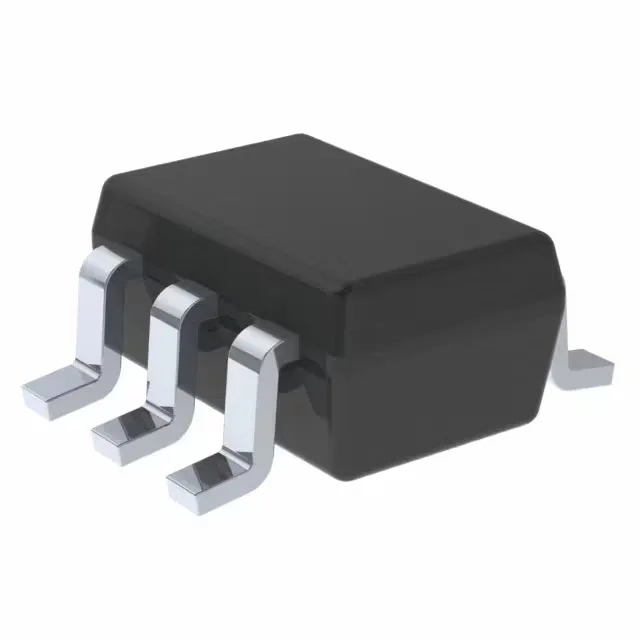
The SC-70-6 (SOT-363) footprint is about 2.1 mm × 2.0 mm. Four I/O pins, one VCC, one GND. The routing trick is keeping the traces from the connector to the I/O pins as short and direct as possible — every millimeter of stub adds inductance that degrades clamping during a fast ESD event. The VCC pin should connect to the local rail with a 0.1 µF ceramic right at the pin; that cap provides the low-impedance sink for the steering diode to dump the transient into. Without it, the rail itself bounces and the protection effectiveness drops.