11V clamping — what it means for USB 2.0 signal integrity
Its 11V clamping voltage is the headline spec: that's low enough to protect downstream transceivers from ESD strikes without clipping USB 2.0 differential signal amplitudes. For a USB 2.0 high-speed line running at 480 Mbps, a TVS that clamps above the 3.6 V absolute-max of the PHY won't save it — 11V is a standard protection tier that keeps the signal eye open while shunting ±15 kV air-discharge events. Two independent channels in one SOT-23-6 cover a differential pair (D+ and D-) with a single component, saving board space over discrete TVS diodes.
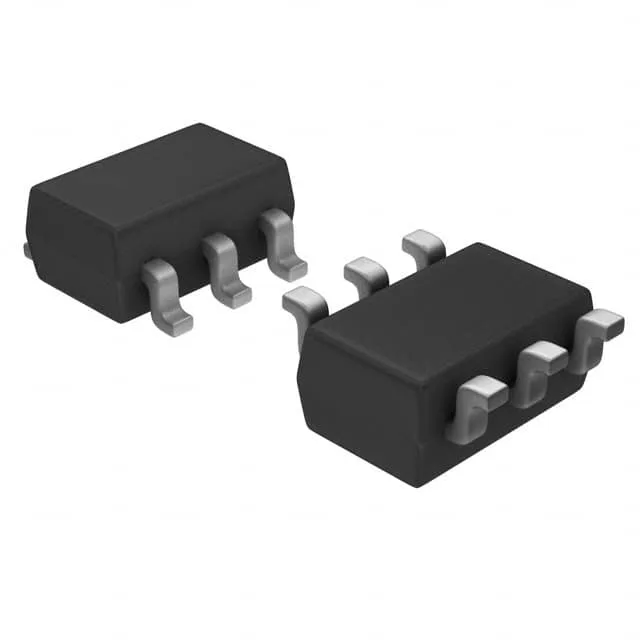
SOT-23-6 footprint — fits tight USB port layouts
Surface-mount assembly means no through-hole rework — pick-and-place ready for volume production. The 2-channel configuration maps naturally to a USB 2.0 D+/D- pair; the third and fourth pins are supply and ground, keeping the routing short. No exposed thermal pad to worry about here — the SOT-23-6 dissipates through the leads, so no via-stitch thermal management needed.
Active lifecycle — no LTB shadow over the BOM line
That means no last-time-buy planning, no shortage-driven panic for this line. The base product number is TPD2S017, so any future die revisions or package variants will carry the same base and be backward-compatible. For procurement: this part is a standard catalog item, not a niche or sunset product, so supply continuity through independent distribution is reliable.