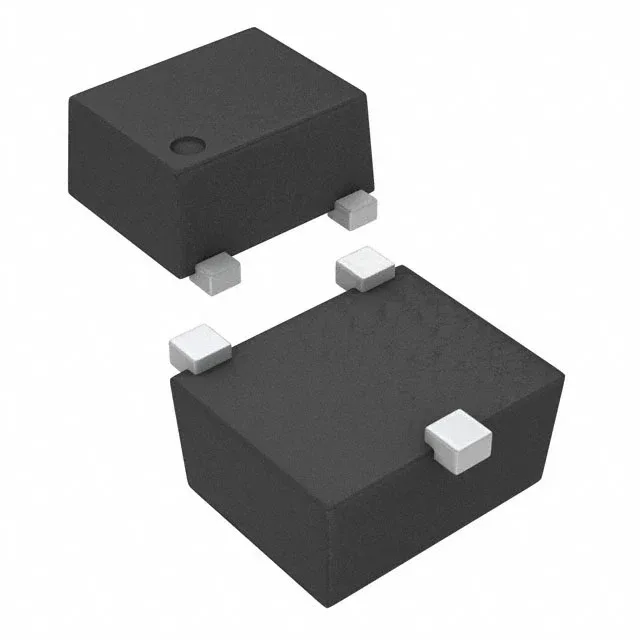
ESD protection for high-speed differential pairs
The Texas Instruments TPD2EUSB30ADRTR is a steering (rail-to-rail) ESD protection diode array designed to shunt transient overvoltages on two unidirectional signal lines. With a reverse standoff voltage of 3.6V (max) and a clamping voltage of 8V at 1A peak pulse current (8/20µs waveform), it protects downstream ICs on USB 2.0, USB 3.0, HDMI, and other high-speed differential interfaces.
Clamping voltage and signal integrity
The 8V clamping voltage at 1A is the key parameter for design margin: it defines the maximum voltage the protected IC's I/O pins will see during an ESD event. For a USB 3.0 PHY with a 3.6V absolute maximum rating, the 8V clamp leaves 4.4V of headroom — adequate for IEC 61000-4-2 level 4 (±8 kV contact, ±15 kV air) when the diode array is placed close to the connector. The low capacitance typical of steering diodes (not specified here, but inherent to the topology) preserves signal edge rates on 5 Gbps USB 3.0 lanes.
Package and footprint for high-speed layout
Housed in a 3-pin SOT-23-3 variant (SOT-3), this surface-mount device occupies minimal board area and places the protection diodes close to the connector pins — a critical practice for minimizing loop inductance and achieving the rated clamping performance. The small footprint suits space-constrained designs in mobile devices, dongles, and compact I/O modules.