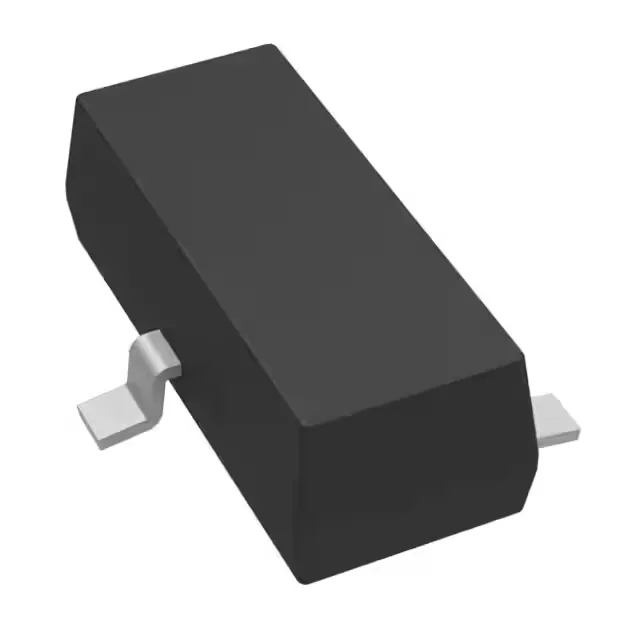
What this ESD diode is and why the AEC-Q101 stamp matters
The Texas Instruments TPD2E2U06QDBZRQ1 is a two-channel steering (rail-to-rail) ESD protection diode in a SOT-23-3 package. If your BOM calls for ESD protection on an Ethernet PHY or a CAN/LIN bus line inside an ECU, this is the grade you need. The rail-to-rail steering topology clamps incoming transients to the positive supply and ground rails rather than to a fixed voltage, which keeps signal integrity intact on high-speed differential pairs.
Two channels, one small package — board-space math
Two unidirectional channels in a single SOT-23-3 footprint means one device protects both lines of a differential pair — Ethernet RX+/RX- or a CANH/CANL pair. That's one pick-and-place event instead of two, and the SOT-23-3 body is small enough to tuck next to the connector or PHY without fighting for board real estate. The supplier device package is SOT-23-3, also listed as TO-236-3 and SC-59 — same footprint, different industry names.
Voltage ratings — what the 5.5V standoff and 6.5V breakdown mean for your rail
That 1V window means this diode is designed for 5V supply rails — it won't conduct leakage during normal operation on a 5V line, but it starts clamping before the voltage rises high enough to damage the protected IC. The typical clamping voltage at peak pulse current is 12.4V, which is the voltage the downstream device sees during an ESD event. For a 5V-tolerant Ethernet PHY or transceiver, that clamp level is within the typical absolute maximum ratings.
Peak pulse power — this is for signal lines, not main bus protection
Peak pulse power is rated at 75W, with a peak pulse current of 5.5A under an 8/20µs waveform. That's a modest rating — this is a low-capacitance steering diode meant for protecting sensitive high-speed data lines, not for shunting high-energy transients on power buses. If your application needs to survive a direct lightning surge on an external cable, you'll want a higher-power TVS upstream. For ESD protection per IEC 61000-4-2 on automotive Ethernet or sensor interfaces, the 75W rating is appropriate.
If you're qualifying a second source, the base product number TPD2E2U06 covers the commercial and industrial temperature variants in the same package, but those lack the automotive qualification.