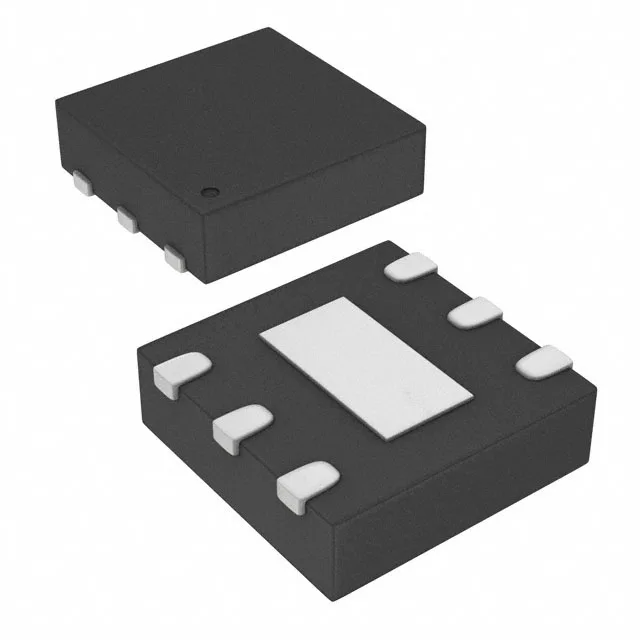
The Texas Instruments TPD2E001DRSR is a steering (rail-to-rail) ESD protection diode array designed to shunt electrostatic discharge away from sensitive IC pins on high-speed data lines. It integrates two unidirectional channels, each rated for a reverse standoff voltage of 5.5V max and a minimum breakdown voltage of 11V, which means it clamps ESD events before they reach the protected device while passing normal signal levels up to 5.5V. The part is explicitly targeted at Ethernet port protection, where it guards the PHY-side differential pairs against ±8 kV contact discharge per IEC 61000-4-2.
Two unidirectional channels — what that means for signal routing
Two unidirectional channels means the TPD2E001DRSR protects two independent signal lines (e.g., TX+ and TX- on an Ethernet differential pair) from positive ESD strikes only. Each channel steers the surge to the positive supply rail (VCC) or to ground via the internal rail-to-rail clamp structure. Because the channels are unidirectional, the part will not clamp negative-going ESD events below ground — the substrate diode handles those — but for Ethernet applications where the common-mode voltage is biased around 0V, this is the standard topology. If you need bidirectional protection on a single line (e.g., a USB D+/D- pair), you would use two channels back-to-back or select a bidirectional array.
The 6-SON (3x3) package is a 6-lead small-outline no-lead with an exposed pad, measuring 3 mm × 3 mm. Surface-mount assembly is straightforward with standard lead-free reflow profiles; the exposed pad provides a low-inductance thermal and electrical connection to ground, which is essential for minimizing the clamping voltage during an ESD event. Keep the ground pad well stitched to the PCB ground plane with multiple vias to keep the surge path short.