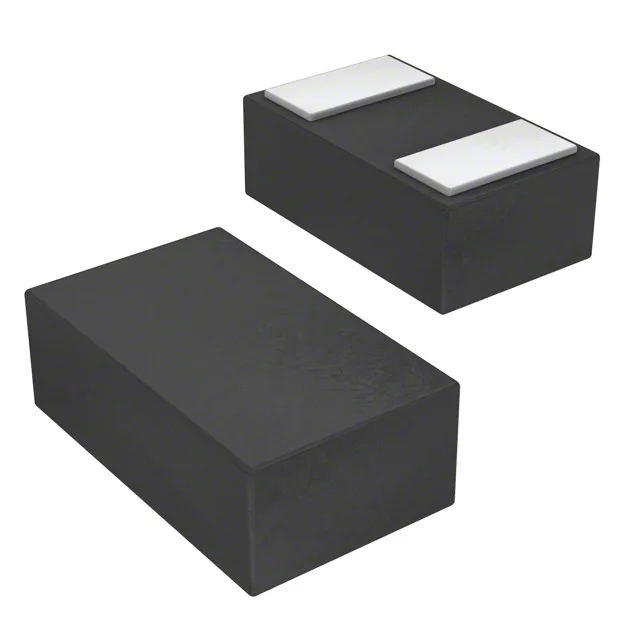
Its standout feature is an ultra-low 0.2 pF capacitance at 1 MHz, which keeps signal integrity intact on differential pairs running at gigabit speeds. Applications listed include Ethernet, HDMI, and USB interfaces — exactly the kind of ports that need a low-capacitance clamp to avoid rounding off fast edges.
The typical clamping voltage at the peak pulse current of 2.5 A (8/20 µs waveform) is 15 V — that's the voltage the protected IC sees during a strike. The bidirectional configuration (one channel) means you can use it across a differential pair without worrying about polarity, and the 0.2 pF capacitance is low enough that a 5 Gbps USB 3.0 or 1 Gbps Ethernet eye diagram won't collapse. Power line protection is not supported — this is strictly a signal-line clamp.
Package and soldering reality
The device comes in a 0402 (1006 Metric) surface-mount package, specifically the 2-X1SON with a body size of 1.0 mm x 0.6 mm. That's tiny — you'll want a fine-tip iron and a steady hand if you're hand-soldering a prototype, or better yet, a hot-air station with a fine nozzle. No exposed thermal pad to worry about, but the small footprint means solder paste volume and stencil aperture need to be dialed in for reflow.