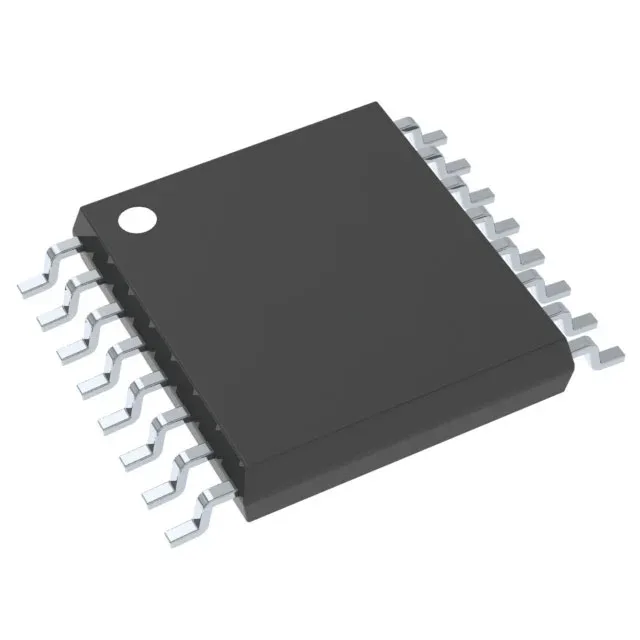
13-channel ESD clamp in a 16-TSSOP — what it covers
The Texas Instruments TPD13S523PWR is a 13-circuit diode array in a 16-TSSOP package, designed as a general-purpose ESD and overvoltage clamp. Each of the 13 channels shares a common 15V clamping rail, so a single device can protect a multi-line interface — think DVI, HDMI, or LVDS data lines — where each differential pair plus the auxiliary signals need a matched clamp threshold. The 15V clamping voltage sits above typical 3.3V and 5V supply rails, meaning the clamp activates only during an overvoltage event, not during normal signal swings.
Clamping voltage — why 15V matters for your rail budget
The 15V clamping voltage is the voltage at which the diode array begins to conduct and shunt excess current to the supply or ground. For a 3.3V or 5V I/O bank, a 15V clamp gives roughly 10V of headroom above the normal operating level — enough to absorb ESD strikes without clipping legitimate signal peaks. If your downstream ICs have a lower absolute maximum rating (e.g., 3.6V on a 3.3V GPIO), the 15V clamp still protects because the series resistance and the IC's own on-die ESD structure share the energy; the array limits the peak voltage seen by the protected line. For designs where the protected bus runs at 12V or higher, the 15V clamp may trigger during normal operation — check the signal swing against the 15V threshold before committing the BOM.
13 circuits in a 16-pin package — how the density works
Thirteen clamping circuits in a 16-TSSOP body (4.40 mm wide) means the TPD13S523PWR packs a high channel count into a small footprint. The 16 pins include 13 signal inputs (one per channel) plus a common cathode and a common anode — or a similar shared-rail topology — so the package accommodates 13 protected lines with only three additional pins for the supply and ground references. This density suits designs where board area is tight and many differential pairs or single-ended signals need ESD protection without dedicating a separate TVS diode per line.