3.2 W per channel into 4 Ω — what that means for the speaker load
The TPA2026D2YZHT delivers 3.2 W per channel into a 4 Ω load, both channels driven simultaneously. That output power is measured at the device pins — the actual SPL at the speaker depends on the enclosure and driver efficiency, but the amplifier itself won't be the bottleneck for a portable Bluetooth speaker or a docking station channel. At 3.6 V battery mid-point, expect roughly 1.5–2 W per channel into 4 Ω — the 3.2 W headline figure is reached at the 5.0 V supply end of the range.
I²C volume and SmartGain™ — what the control bus buys you
Volume is set via I²C, not a potentiometer or DC voltage — the gain register is 32-step from mute to +24 dB. That eliminates the wiper-noise and tracking-error issues of an analog pot in a portable product. SmartGain™ is an automatic gain control (AGC) that prevents the output from clipping when the input signal exceeds the supply headroom. The attack and release times are programmable over I²C — useful when the source is a Bluetooth stream with unpredictable peak levels. Differential inputs reject common-mode noise from the ground loop between the codec and the amplifier — a real concern when the two ICs sit on opposite sides of a two-layer board.
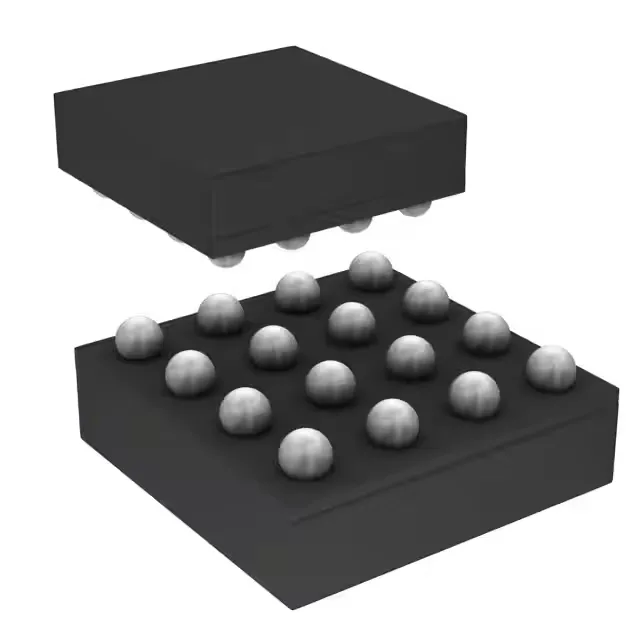
Package and thermal reality — 16-DSBGA (2.24 × 2.16 mm)
The 16-DSBGA package measures 2.24 × 2.16 mm with a 0.50 mm ball pitch. That pitch is fine for a two-layer board if the fan-out traces are 0.10 mm width — four-layer is safer for production yield. The Class-D output stage runs cool at typical listening levels — efficiency is above 85 % at 1 W output, so the die temperature stays well below 85 °C ambient even without a heatsink. The DSBGA's thermal pad on the bottom side should be connected to a ground plane pour for best thermal transfer. Surface-mount only — no through-hole variant exists. The DSBGA package requires a solder-paste stencil and reflow profile; hand-soldering is not practical.
A portable instrument that plays audio prompts outdoors in winter or a dashcam that sits in a parked car in summer stays within the rated junction temperature.