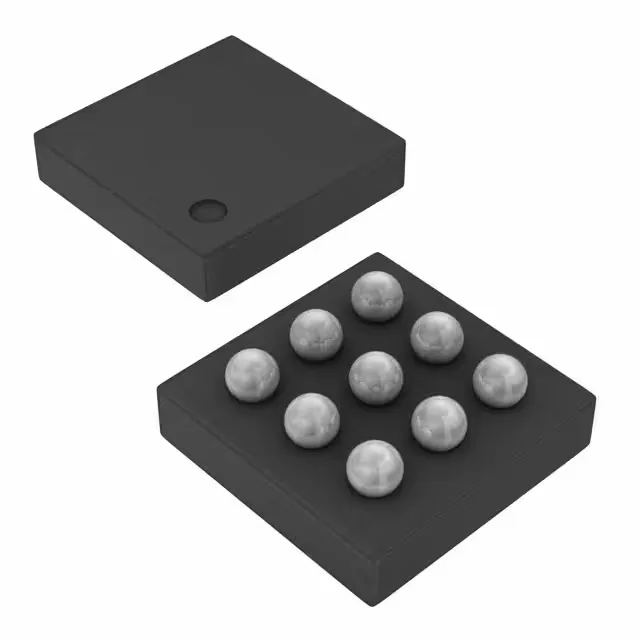
Class D amplifier in a 9-ball DSBGA — board-fit and thermal story
The TPA2011D1YFFT: The 9-DSBGA package (0.4mm pitch, 0.9mm x 1.3mm footprint) demands a controlled solder-paste volume and a reflow profile matched to the JEDEC J-STD-020 moisture sensitivity level — the small ball diameter means the standoff height is minimal, so board flatness and stencil aperture design directly affect solder-joint reliability. The differential inputs reject common-mode noise picked up on long PCB traces between the codec and the amplifier — a practical advantage when the audio source is on a separate board or a flex cable.
Output power and supply-voltage planning
The 3.24W output into 4Ω is the maximum continuous power at 10% THD+N with a 5V supply. At 3.6V (typical Li-ion nominal), the output drops to roughly 1.7W into 4Ω — budget the supply rail and speaker impedance together to meet the target SPL. The 2.5V minimum supply means the amplifier still operates from a deeply discharged single-cell battery, though output power is reduced proportionally. The shutdown feature pulls the quiescent current below 1 µA when the active-low enable pin is driven low — this is the power-down state for battery-powered products that need to pass standby current limits. The short-circuit and thermal protection circuits are self-resetting; they latch the output off until the fault clears, then the amplifier resumes normal operation without a power cycle.
Active lifecycle and compliance documentation
ROHS3 compliance (EU 2015/863) is confirmed, covering all ten restricted substances including the four phthalates added in the 2015 amendment.