Active production — no BOM risk for this amplifier
The TPA2011D1YFFR: ROHS3 compliant without lead-free exemption — no regulatory roadblock for EU or China market shipments.
3.24 W mono into 4 Ω — sizing the speaker load
Rated 3.24 W continuous into a 4 Ω load from a single channel — this is the maximum output before clipping at the specified supply voltage. Class-D topology means the output stage switches at high frequency, so the efficiency stays above 80 % across most of the power range — the heatsink can be minimal or omitted in many portable designs.
9-DSBGA — tiny footprint, plan the rework
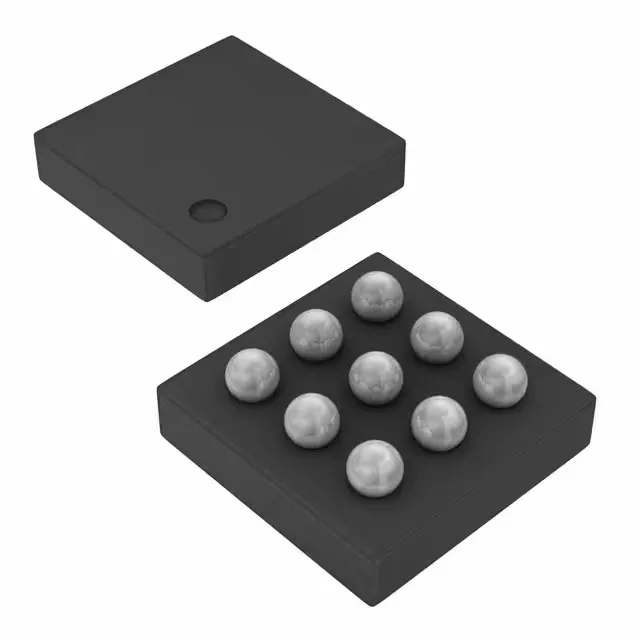
Housed in a 9-bump DSBGA (0.4 mm pitch, no exposed thermal pad) — the package itself is smaller than a 0603 resistor, so the board area savings are real, but hand rework without a hot-air station is impractical. The bump layout is symmetrical with a pin-1 indicator — verify the orientation mark on the PCB silkscreen before reflow; a mis-oriented part is a board spin.
Integrated protection — fewer external parts
Short-circuit and thermal protection are on-chip — the amplifier shuts down before the output stage or speaker is damaged, so no external current-sense resistor or thermal switch is needed. A dedicated shutdown pin lets a GPIO or a system supervisor pull the amp into low-power mode when the audio path is idle. Differential inputs reject common-mode noise picked up on long traces between the codec and the amplifier — useful when the amp sits on a separate board or a noisy power plane.