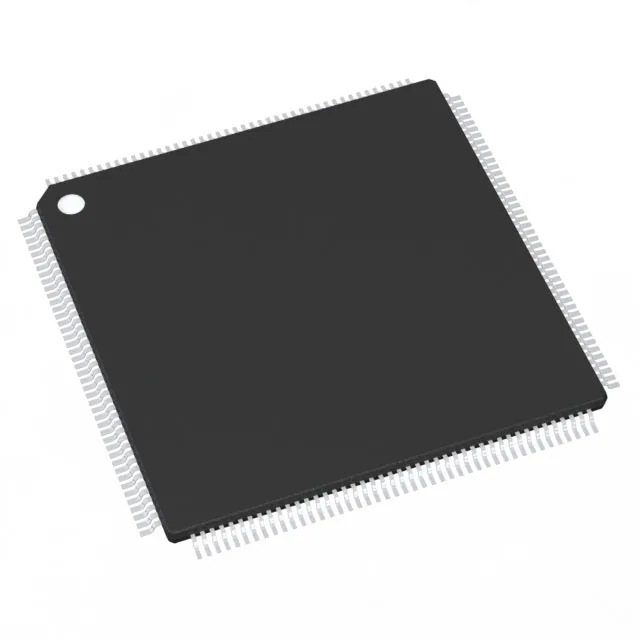
200 MHz C28x core for real-time control loops
Its headline spec is the 200 MHz core speed — enough headroom to run a pair of servo loops or a dual-motor field-oriented control algorithm without splitting cycles. The 1 MB Flash (512K x 16) and 82K x 16 RAM give firmware room for three-phase commutation tables, safety diagnostics, and a communication stack on the same die.
AEC-Q100 and 125°C — built for under-hood duty
That puts it in the bracket for engine control units, transmission controllers, and electric-drive inverters where the ambient under the hood can hit 105°C and the junction sees 125°C. The 176-HLQFP with exposed pad (24x24 mm) pulls heat into the PCB plane — get the via stitch under the pad right and the thermal margin stays comfortable at 200 MHz continuous.
Dual 16-bit ADC bank — sample two currents at once
The data converter block pairs 20 channels of 12-bit ADC with another 20 channels of 16-bit ADC, plus three 12-bit DACs. In a motor-drive design you can assign one 16-bit ADC to phase-A current and the other to phase-B, capture both on the same PWM trigger, and close the current loop with no interleaving delay. The 3x 12-bit DACs serve as set-point outputs or analog watchdog comparators.
Connectivity covers CANbus, I²C, SCI (UART), SPI, McBSP, USB, and a uPP parallel port — enough to talk to a resolver interface, an external encoder, and a gateway controller on the same chip. The 97 GPIOs and the DMA engine offload the C28x core from moving data between the ADC result registers and the PWM compare values.
Package and rework — 176-HLQFP with exposed pad
The 176-lead HLQFP is a QFP with a thermal pad underneath — not a BGA, so you can rework it with a hot-air station and a stencil.
No last-time-buy notice, no end-of-life announcement. For a new automotive program this is a safe selection — TI continues to support the Delfino line with roadmap updates. The base product number is TMS320, so PCN and errata notifications are published under that family.