150 MHz floating-point DSP with automotive-grade reliability
The device is qualified to AEC-Q100, making it suited for automotive powertrain, chassis control, and industrial motor-drive applications where deterministic real-time control is required.
Memory and peripheral headroom for real-time loops
The 256 KB Flash is sized for moderate firmware images — think field-oriented control (FOC) algorithms with lookup tables, or CANopen stacks with a few application layers. The 36 KB RAM provides enough buffer for two or three concurrent control loops plus data logging. The CAN 2.0B module handles J1939 or CANopen frames directly; the SPI and UART interfaces connect to external ADCs, encoders, or serial displays without glue logic.
179-NFBGA package — layout and rework considerations
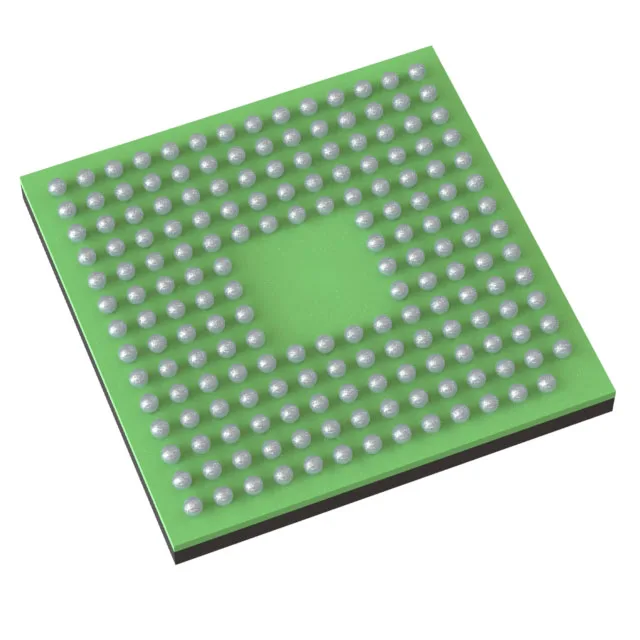
Housed in a 179-NFBGA (12x12 mm) package, the TMS320F2812ZAYAR requires a multi-layer PCB with microvia capability for fanout. The core voltage is 1.9 V, separate from the 3.3 V I/O supply — plan for a dedicated 1.9 V rail with adequate decoupling near the BGA pads. Reworking this BGA by hand is possible with a preheat plate and a hot-air nozzle sized for the 12 mm body; a stencil for solder paste and a reflow profile tuned to the MSL rating are recommended.
Industrial temperature range and qualification
The AEC-Q100 qualification adds stress-tested reliability for high-vibration and thermal-cycling conditions — a requirement for under-hood ECUs and transmission controllers.