Core architecture and memory headroom
The TMS320C6748EZWT3 is a fixed/floating-point DSP from the TMS320C674x series, clocked at 375 MHz. The 448 kB on-chip RAM is the working memory for real-time signal processing — for a typical audio beamforming or motor-control algorithm, this keeps the active coefficient arrays and buffer frames on-chip, avoiding the latency of external memory access. Non-volatile memory is external, so the boot image lives in a serial NOR flash or NAND on the board. The 375 MHz core with the floating-point unit handles both fixed-point and floating-point math natively — no software emulation penalty for algorithms that need the dynamic range of float.
Peripheral set and system integration
The interface list includes EBI/EMI for parallel memory or FPGA glue, an Ethernet MAC for networked control, a Host Interface for connection to an application processor, plus I²C, McASP (multichannel audio serial port), SPI, UART, and USB. This covers the common connectivity for an industrial audio processor, a software-defined radio front-end, or a multi-axis servo controller. The Ethernet MAC is a key differentiator from the lower-end C674x parts — it allows direct connection to a plant network without an external PHY chip on the MAC side (the PHY is still needed on the line side). For a system architect, this saves a BOM line and simplifies the PCB routing.
The core voltage is programmable across 1.00 V, 1.10 V, 1.20 V, and 1.30 V, allowing the designer to trade off power against maximum operating frequency. Operating temperature is 0°C to 90°C junction. This is the commercial-grade range — suitable for indoor equipment, test and measurement, and telecom central-office gear. For an outdoor or under-hood deployment, the wider-temperature sibling (TMS320C6748BZWT3, -40°C to 105°C) would be the correct choice.
Package and board-fit
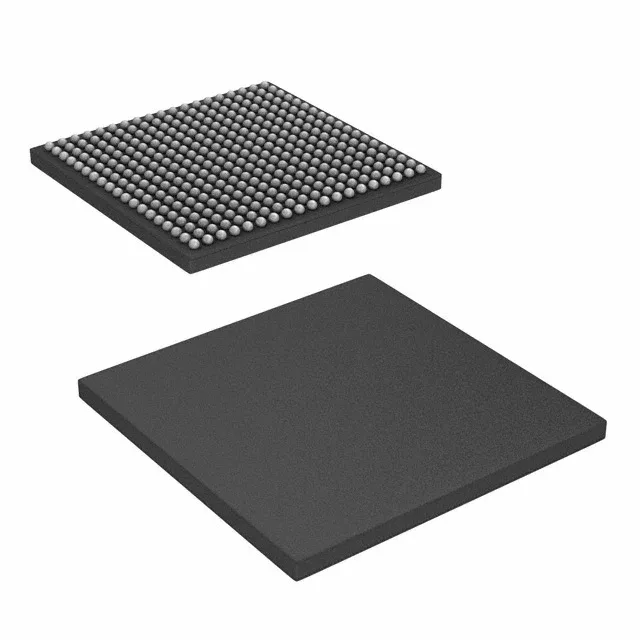
The device comes in a 361-ball NFBGA, 16x16 mm body. The 0.80 mm ball pitch is standard for this density — a 4-layer PCB with via-in-pad or microvia fan-out is typical. The mounting type is surface mount, and the standard delivery is in trays. No reel packaging is listed, so for high-volume pick-and-place, a tray-to-reel transfer at the distributor or a custom tape-and-reel order may be needed.
The series is TMS320C674x, a long-running family with multiple speed grades and temperature options. If the 375 MHz commercial-grade variant is not available, the same package footprint is shared across the C6748 family, so a speed or temperature upgrade is a drop-in replacement on the same PCB layout.