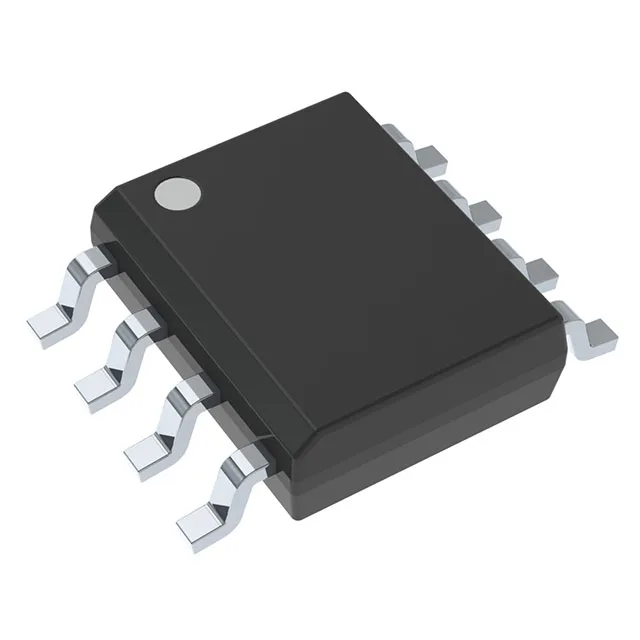
Hall-effect current sense with ratiometric voltage output
The TMCS1100A4QDT is a single-channel Hall-effect current sensor from Texas Instruments that outputs a ratiometric voltage proportional to the sensed current. Sensitivity is 400 mV/A, meaning each amp of measured current produces 400 mV at the output pin — a 5 A load gives 2.0 V out, leaving headroom to the 5 V supply rail. It measures both AC and DC without external polarity handling, and the Hall-effect front end provides galvanic isolation between the current-carrying conductor and the output stage — no shunt resistor, no insertion loss.
Bandwidth, linearity, and the overcurrent detection window
Small-signal bandwidth is 80 kHz, which means the sensor can track current waveforms up to that frequency — adequate for 50/60 Hz mains monitoring, motor phase currents up to the switching ripple, and DC-link ripple in a typical VFD. The 6.5 µs response time sets the propagation delay from a current step to the output crossing a threshold; a controller sampling at 10 kHz has plenty of margin to catch a fault before the next cycle. Linearity is ±0.05% of full scale, so the measurement error from the sensor itself is below half a milliamp at 1 A — the dominant error in a real BOM will be the ADC's reference drift and noise, not the Hall element. Supply range is 4.5 V to 5.5 V, typical for a ratiometric sensor that shares a 5 V rail with the ADC reference. Because the output is ratiometric, any drift in the supply voltage cancels at the ADC if the reference tracks the same rail.
Package, temperature grade, and supply current
Housed in an 8-pin SOIC (8-SOIC, 3.90 mm body width) — a standard SMT footprint that reflows on any normal lead-free profile. The supplier device package is 8-SOIC; no exposed pad, no special thermal vias required. Operating temperature range is -40°C to +125°C ambient, covering industrial enclosures, outdoor telecom cabinets, and under-hood automotive zones. The device draws a maximum of 6 mA from the supply rail — negligible in a 5 V system, but worth checking if the sensor is powered from a low-dropout regulator near its dropout floor.