What the 100 mV/A sensitivity and 80 kHz bandwidth mean for your BOM
The TMCS1100A2QDT is a Hall-effect current sensor from Texas Instruments that outputs a ratiometric voltage proportional to the sensed AC or DC current. Its 100 mV/A sensitivity means that at 10 A the output swings 1 V, which maps cleanly into a 3.3 V ADC input range with headroom for transients. The 80 kHz bandwidth covers the switching fundamentals of most motor drives and power converters up to several tens of kHz, while the 6.5 µs response time is fast enough for cycle-by-cycle overcurrent detection in SMPS loops or short-circuit protection in inverter stages. The ratiometric output scales with the 3 V to 5.5 V supply rail, so accuracy is maintained even when the supply is noisy or varies — a useful trait in automotive or industrial backplanes where the 5 V rail may droop under load.
Active lifecycle and sourcing posture
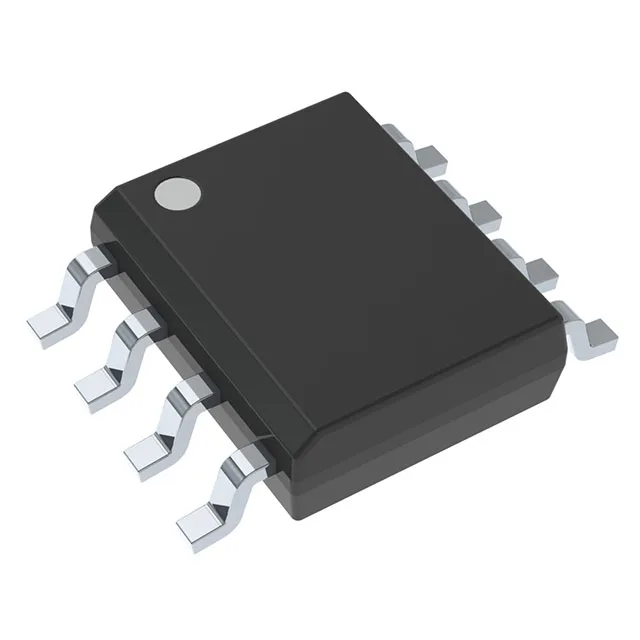
Texas Instruments lists the TMCS1100A2QDT as Active — no end-of-life notice or last-time-buy pressure. This part is sourced through authorized distribution channels and quoted to order against your BOM quantity. Availability and current pricing are confirmed at RFQ time. The 8-SOIC package (3.90 mm width) is a standard surface-mount footprint with wide second-source compatibility for layout reuse. The operating temperature range of -40°C to 125°C covers industrial and underhood automotive ambient conditions.
Where this sensor fits in the signal chain
The TMCS1100A2QDT is a single-channel Hall-effect sensor for measuring AC or DC current without a shunt resistor, saving power and avoiding ground-loop insertion loss. Its ±0.05% linearity and ratiometric voltage output make it suitable for precision current monitoring in motor drives, battery chargers, power supplies, and load-monitoring circuits. The 6 mA maximum supply current is low enough to be powered from a reference rail or a small LDO, simplifying the bill of materials in space-constrained designs.