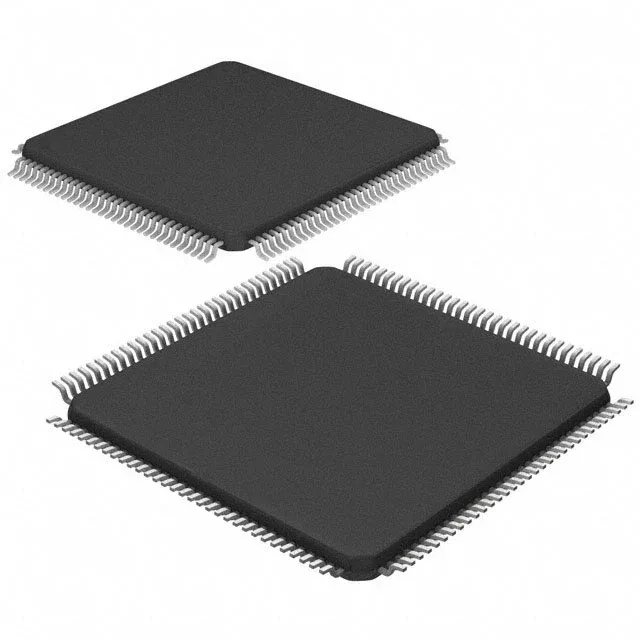
Texas Instruments TM4C129ENCPDTT3R — Microcontrollers & Processors (MCU / MPU / DSP)

TM4C129ENCPDTT3R Tiva™ C ARM Cortex-M4F MCU, 120 MHz, 1 MB Flash

MPNTM4C129ENCPDTT3R
Active

Texas Instruments Tiva™ C series TM4C129ENCPDTT3R, 32-bit ARM Cortex-M4F MCU, 120 MHz, 1 MB Flash, 256 KB RAM, Ethernet MAC+PHY, CAN, USB OTG, 90 GPIO, 128-TQFP, -40 to 105 °C.

$14.0528Ref. price · indicative, final on quote
Independent supplier — new & surplus stockAuthenticity-screened · ESD-safe packingListing updated Jul 2026

Specifications

TM4C129ENCPDTT3R specifications
ParameterValue
SeriesTiva™ C
MountingSurface Mount
Oscillator typeInternal
Program memory typeFLASH
Voltage - supply (Vcc (Vdd))2.97V ~ 3.63V
Operating temperature-40°C~105°C(TA)
Speed120MHz
PackageTape & Reel (TR)
RAM size256K x 8
Core size32-Bit Single-Core
EEPROM size6K x 8
PeripheralsBrown-out Detect/Reset, DMA, Motion Control PWM, POR, PWM, WDT
ConnectivityCANbus, EBI/EMI, Ethernet, I²C, IrDA, QEI, SPI, SSI, UART/USART, USB OTG
Number of i (O)90
Core processorARM® Cortex®-M4F
Case128-TQFP
Data convertersA/D 20x12b
Program memory size1MB (1M x 8)

Product details

120 MHz Cortex-M4F — what the core speed means for a connected design

The 120 MHz clock rate on a Cortex-M4F with FPU is enough to run a real-time Ethernet protocol stack (EtherNet/IP, PROFINET RT, Modbus TCP) alongside a control loop and a display update. The FPU handles single-precision math in hardware, so PID coefficients or FFT bins don't eat into the instruction budget the way they would on an M3 or M0. If your application runs a web server on the internal MAC plus a CANopen node and a 1 kHz current loop, this core keeps the margin — you won't need to offload to a separate communications processor.

1 MB Flash and 256 KB RAM — sizing the firmware and data buffers

1 MB of Flash holds a full TCP/IP stack, a file system, and several hundred kilobytes of application code. The 256 KB SRAM is split across multiple buses; the Ethernet controller can use a dedicated DMA channel for packet buffers without starving the CPU. If you are logging data or buffering large CAN messages, the RAM budget supports moderate ring buffers — but a design that streams video or stores a full web page for every connected device will need external SDRAM over the EBI/EMI interface.

Package and footprint — 128-TQFP with 14x14 mm body

Housed in a 128-lead TQFP with a 14x14 mm body. The package is surface-mount, suitable for standard reflow soldering. The 90 GPIO pins are distributed around all four sides.

Frequently asked questions

What is TM4C129ENCPDTT3R's listed speed?

The core is rated at 120 MHz, based on the ARM Cortex-M4F with single-cycle multiply and hardware floating-point. This speed determines the throughput for real-time control loops and protocol stack processing.

What connectivity interfaces does TM4C129ENCPDTT3R include?

The MCU integrates Ethernet MAC with PHY, dual CAN 2.0, USB OTG, plus multiple serial interfaces: UART/USART, I²C, SPI, SSI, IrDA, and QEI. It also provides an external bus interface (EBI/EMI) for memory expansion.

What is the operating temperature range of TM4C129ENCPDTT3R?

The device is rated for -40 to 105 °C ambient, which qualifies it for industrial environments such as factory automation, outdoor telecom cabinets, and under-hood automotive applications.