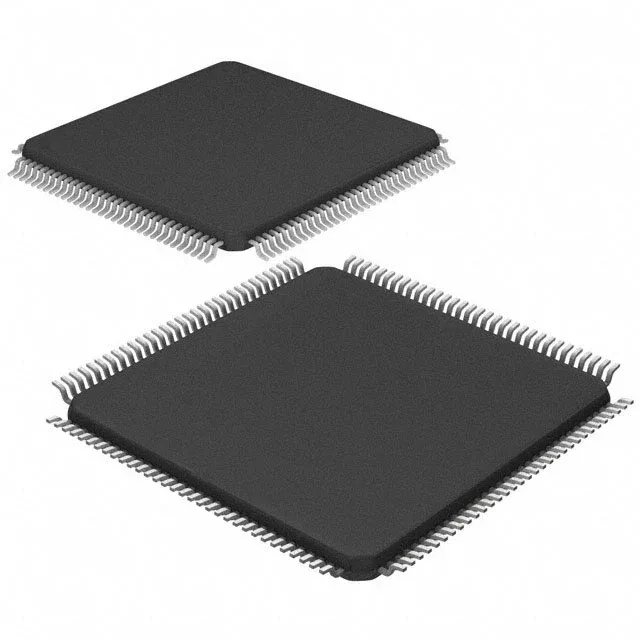
Texas Instruments TM4C129DNCPDTT3 — Microcontrollers & Processors (MCU / MPU / DSP)

TM4C129DNCPDTT3 Tiva C Cortex-M4F MCU, 120MHz, 1MB Flash

MPNTM4C129DNCPDTT3
Active

Texas Instruments Tiva™ C Series TM4C129DNCPDTT3, ARM® Cortex®-M4F, 120MHz, 32-Bit Single-Core, 1MB (1M x 8) FLASH, 256K x 8 RAM, 6K x 8 EEPROM, 90 I/O, 128-TQFP, -40°C~105°C.

$18.3786Ref. price · indicative, final on quote
Independent supplier — new & surplus stockAuthenticity-screened · ESD-safe packingListing updated Jul 2026

Specifications

TM4C129DNCPDTT3 specifications
ParameterValue
SeriesTiva™ C
MountingSurface Mount
Oscillator typeInternal
Program memory typeFLASH
Voltage - supply (Vcc (Vdd))2.97V ~ 3.63V
Operating temperature-40°C~105°C(TA)
Speed120MHz
PackageTray
RAM size256K x 8
Core size32-Bit Single-Core
EEPROM size6K x 8
PeripheralsBrown-out Detect/Reset, DMA, Motion Control PWM, POR, PWM, WDT
ConnectivityCANbus, EBI/EMI, Ethernet, I²C, IrDA, QEI, SPI, SSI, UART/USART, USB OTG
Number of i (O)90
Core processorARM® Cortex®-M4F
Case128-TQFP
Data convertersA/D 20x12b
Program memory size1MB (1M x 8)

Product details

120 MHz Cortex-M4F with integrated Ethernet — what that means for a motor-drive or gateway BOM

It carries 1 MB of program Flash and 256 KB of SRAM, plus 6 KB of EEPROM for nonvolatile parameter storage.

Memory and peripheral sizing — the BOM-fit check

With 1 MB of Flash you can host a full Ethernet stack, a CANopen or EtherCAT slave library, and the application code without needing external serial Flash for most designs. The 256 KB SRAM is enough for double-buffered Ethernet frames and a moderate data-logging buffer. The 6 KB EEPROM is useful for storing calibration constants and node IDs without wearing the Flash. The 90 GPIOs in the 128-TQFP package give headroom for a parallel LCD interface or a bank of opto-coupled inputs on a motor-drive control card.

Frequently asked questions

What is the difference between TM4C129DNCPDTT3 and TM4C129ENCPDTT3?

The TM4C129ENCPDTT3 is a pin-compatible variant within the same Tiva C family. The primary difference is that the 'E' version adds a cryptographic accelerator (AES, DES, SHA) and a hardware CRC module, while the 'D' version (this part) omits those security blocks. Both share the same 120 MHz Cortex-M4F core, 1 MB Flash, 256 KB SRAM, Ethernet MAC+PHY, and CAN controllers. If your application does not need hardware cryptography, the TM4C129DNCPDTT3 is the cost-optimized choice.