That core speed means the MCU can run a real-time control loop — say, a motor FOC at 20 kHz — while simultaneously handling Ethernet packet processing and a touchscreen HMI without a separate communications processor. The 1 MB Flash and 256K x 8 SRAM give enough room for a full TCP/IP stack, a FreeRTOS or TI-RTOS kernel, and application code for an industrial gateway or a building automation controller.
Connectivity set — Ethernet, CAN, USB OTG, and 90 I/O
This part integrates an Ethernet MAC+PHY, two CAN 2.0 controllers, USB OTG (Host/Device), plus eight UARTs, four SPI/I²C modules, and a QEI for quadrature encoder inputs. That peripheral mix targets exactly the class of designs that need a single-chip controller for a factory-floor gateway: one CAN bus talks to a VFD, the Ethernet port streams telemetry to the cloud, and the USB OTG connects a flash drive for local data logging. The 90 general-purpose I/O, mapped across the 128-TQFP package, leave enough pins for a parallel LCD interface, external memory via the EBI/EMI bus, and a keypad matrix without a port expander.
That means it is suitable for new design-ins and production ramp without an obsolescence clock.
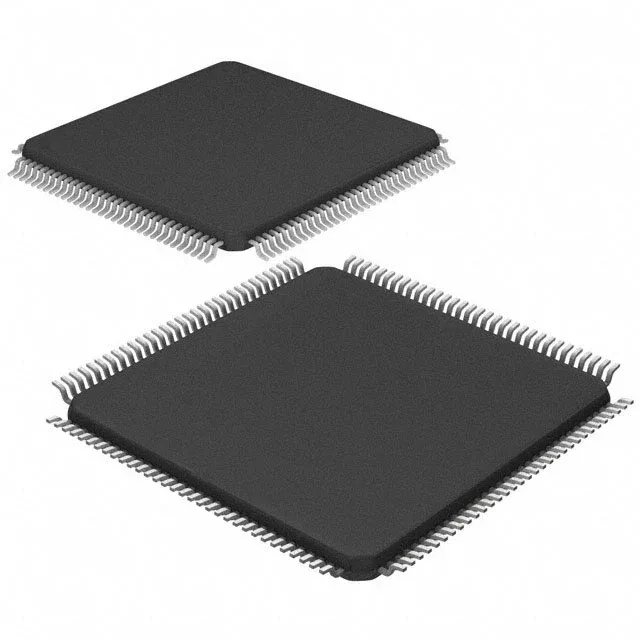
The 128-TQFP (14x14 mm) with 0.4 mm pitch needs a controlled-impedance PCB stack and solder-mask-defined pads; the MSL rating (typically MSL 3) means a bake before reflow if the moisture-barrier bag has been open past the floor-life window.
Supply voltage range and on-chip data converters
The core and I/O operate from 2.97 V to 3.63 V, which is the standard 3.3 V rail with margin for a linear regulator's dropout. The 20-channel 12-bit ADC samples at up to 2 Msps — enough for three-phase current sensing plus a few auxiliary analog inputs in a motor-drive application.