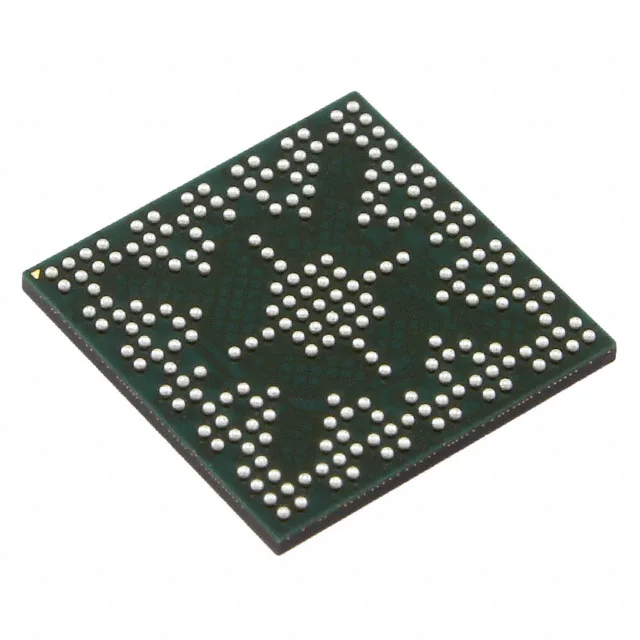
What this Tiva C MCU brings to a control board
The 140 general-purpose I/O lines and 24-channel 12-bit ADC give enough headroom to read a panel of sensors and drive a set of actuators without a CPLD or external mux. The 212-ball VFBGA package (10x10 mm body) keeps the board area tight, but it does mean the assembly line needs a controlled reflow profile and post-solder X-ray inspection — not a hand-solder part.
The floating-point unit (FPU) on the Cortex-M4F means sensor fusion or filter coefficients stay in single-precision float rather than fixed-point scaling — saves firmware development time on the control algorithm. Paired with 256 KB SRAM, there is enough buffer space for two full Ethernet frames plus a TCP/IP stack working set. The 6 KB EEPROM is useful for storing production calibration data or node configuration that must survive a firmware update — no separate serial EEPROM footprint needed on the board.