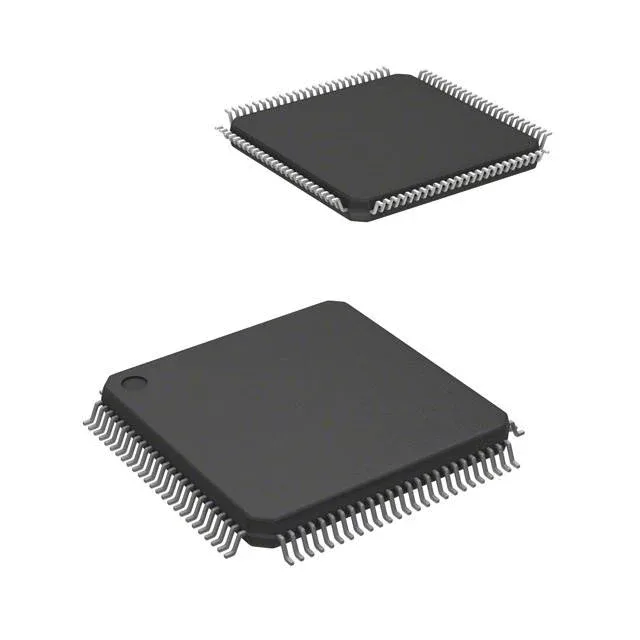
ARM Cortex-M4F with FPU at 80 MHz — what it buys you
That FPU is the real differentiator versus a plain Cortex-M3: it handles math-heavy control loops, sensor fusion, and audio processing in hardware rather than software, so you avoid spending MIPS on integer emulation. There's also 2 KB of EEPROM for calibration constants or boot-config parameters that survive a firmware update without wearing the Flash.
Connectivity and I/O — the peripheral set
A quadrature encoder interface (QEI) is included for motor-position feedback, and the 12-bit ADC has 22 channels — enough to sample three-phase currents plus a handful of analog sensors without external muxing.