That FPU cuts the cycle count on PID, FFT, and sensor-fusion math versus a software-emulated approach — relevant if you are closing a motor-current loop or processing encoder quadrature in firmware rather than offloading to an external FPGA. Memory budget: 256 KB Flash for program storage and a 32 KB SRAM array organized as 32K x 8. That SRAM is tight for a full TCP/IP stack with large buffers; plan for external serial RAM or a lean protocol like CANopen if the application carries a lot of data logging. The 2 KB EEPROM emulation space handles calibration constants and fault counters without wearing the Flash.
Industrial temperature range — deployment envelope
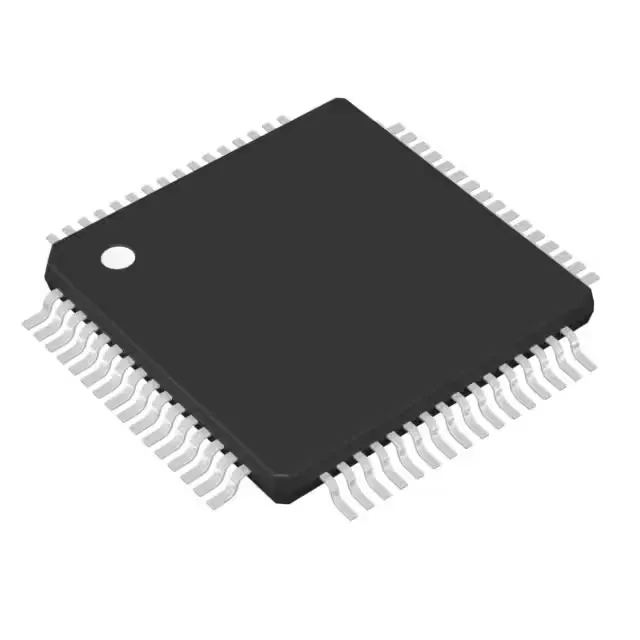
Packaged in a 64-LQFP (10x10 mm body) with 43 GPIOs brought out. The LQFP footprint is hand-solderable for prototypes but requires a stencil for production reflow. This specific variant ships in Tape & Reel, not tray — factor that into pick-and-place setup and minimum order quantity if your line is set up for JEDEC trays.
Lifecycle reality — EOL hot, act now
The TM4C123FH6PMT7R carries an EOL hot lifecycle flag. That means the last-time-buy window is open but narrowing. If this part is locked into a production BOM, secure lifetime-buy quantities now or begin qualification of a replacement. The base product number TM4C123 covers a range of Flash and package options — a pin-compatible sibling with the same 64-LQFP footprint and 80 MHz core may be available as a drop-in, but verify the specific memory and peripheral set against your firmware image.