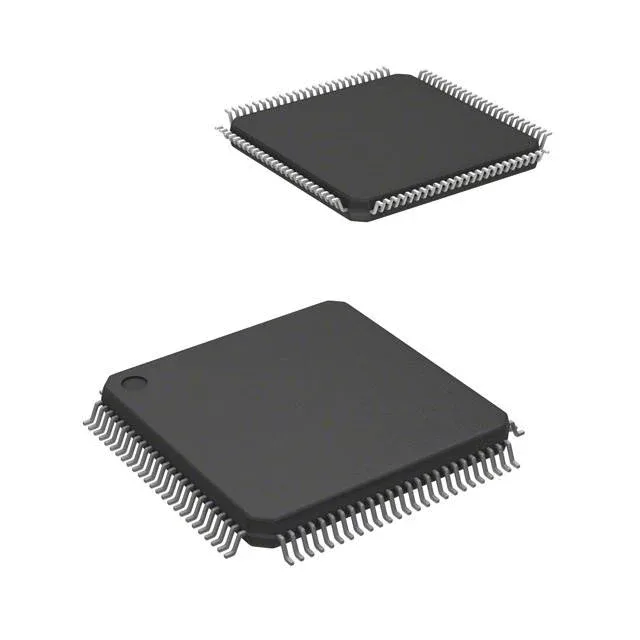
What this Tiva C Series MCU brings to a control board
The 22-channel 12-bit ADC handles multi-sensor inputs like current shunts, thermistors, and potentiometers without an external analog mux.
The ARM Cortex-M4F core includes a single-precision floating-point unit that executes multiply-accumulate in one cycle. For a PID loop running at 10 kHz, the FPU handles the coefficient math in firmware rather than requiring an external DSP or a lookup table. The 80 MHz clock gives about 12.5 ns per instruction cycle — enough headroom for a 20 kHz current loop with a few hundred lines of C code before you hit the timing wall. The internal oscillator means it boots without a crystal — useful for a quick prototype or a cost-sensitive run where ±1% accuracy is acceptable.
Memory sizing for a typical BOM
256 KB of Flash fits a FreeRTOS kernel, a CANopen or Modbus stack, and about 80 KB of application code before you start compressing. The 32 KB SRAM holds a couple of 1 KB CAN message buffers, a 4 KB TCP stack, and still leaves room for a 16 KB data acquisition ring buffer. The 2 KB EEPROM is handy for calibration constants and serial numbers — no external 24LCxx needed.
The base product number TM4C123 covers a range of Flash and pin-count options, so if a future design needs more memory or I/O, a pin-compatible migration within the family is possible without a board spin.