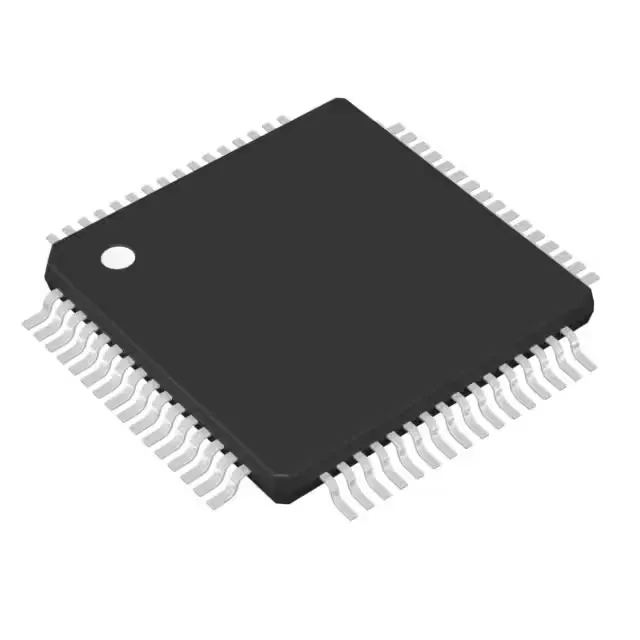
80 MHz Cortex-M4F with FPU — real-time headroom for sensor-fusion loops
That FPU offloads the core for sensor-fusion math or motor-control PID loops without cycle-counting. The 128 KB Flash and 32K x 8 RAM suit firmware footprints that stay on-chip — no external memory bus needed for most industrial-control or IoT-edge applications. The 2K x 8 EEPROM holds calibration constants or boot parameters without wearing the Flash. The peripheral set includes CANbus, I²C, SPI, UART, and QEI — the CAN interface is the deciding factor for automotive or factory-floor networks where legacy CAN 2.0B nodes still dominate. The 12-channel 12-bit ADC captures analog sensor arrays without an external multiplexer.
For a BOM freeze, the active status removes the urgency to qualify a second source today. That said, the TM4C123 series has multiple density and package variants sharing the same Cortex-M4F core and peripheral map — a drop-in migration path exists within the family if a future capacity constraint hits the 64-LQFP line. The base product number TM4C123 is the cross-reference anchor for that family.
Connectivity set — CANbus is the deciding interface
The TM4C123BE6PMIR carries CAN 2.0B, I²C, SPI, SSI, UART, and QEI. For a design that needs CAN, this part eliminates an external CAN transceiver interface chip.