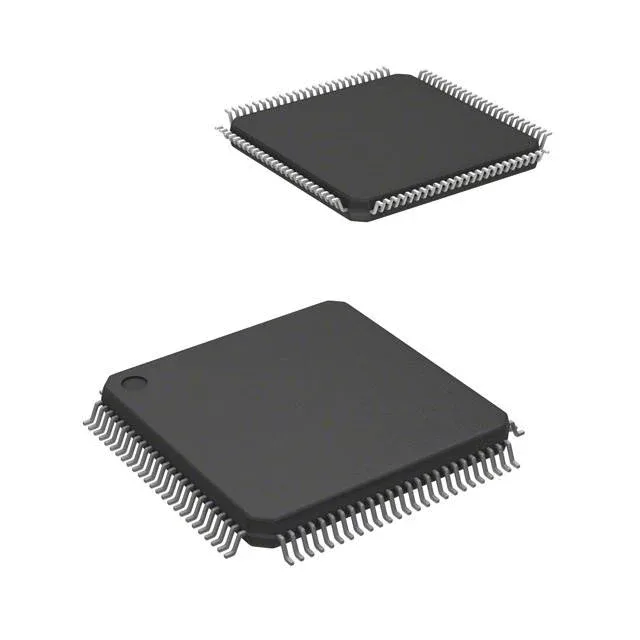
It packs 256 KB of Flash, 32 KB of SRAM, and 2 KB of EEPROM on a single die, and is housed in a 100-LQFP package with 69 general-purpose I/Os. The part targets real-time control, sensor fusion, and industrial connectivity applications where a DSP-capable MCU with USB and CAN interfaces is needed.
The 80 MHz core with single-cycle MAC and hardware divide handles time-critical loops. The floating-point unit offloads trigonometric and filter math from software emulation.
Memory map: Flash, SRAM, and EEPROM sizing
256 KB of Flash (256K x 8) supports a moderate firmware stack with a real-time OS, USB stack, and application code. The 32 KB SRAM (32K x 8) is adequate for data buffers and stack, but designs with large frame buffers or extensive logging may need external SRAM or careful memory partitioning. The 2 KB EEPROM (2K x 8) stores calibration constants, node IDs, and fault logs without requiring external storage or Flash emulation routines — useful for field-updatable parameters that survive reset.
Connectivity and I/O: USB, CAN, and serial interfaces
This set covers the typical industrial communication mix: CAN for machine-to-machine links, USB for configuration or data logging, and SPI/I²C for sensor arrays and external ADCs. The 69 GPIOs in the 100-LQFP package leave room for parallel LCD interfaces, keypad matrices, and status LEDs without bit-banging critical serial lines.
The internal oscillator and brown-out detect circuitry reduce external component count in harsh conditions where crystal reliability is a concern.