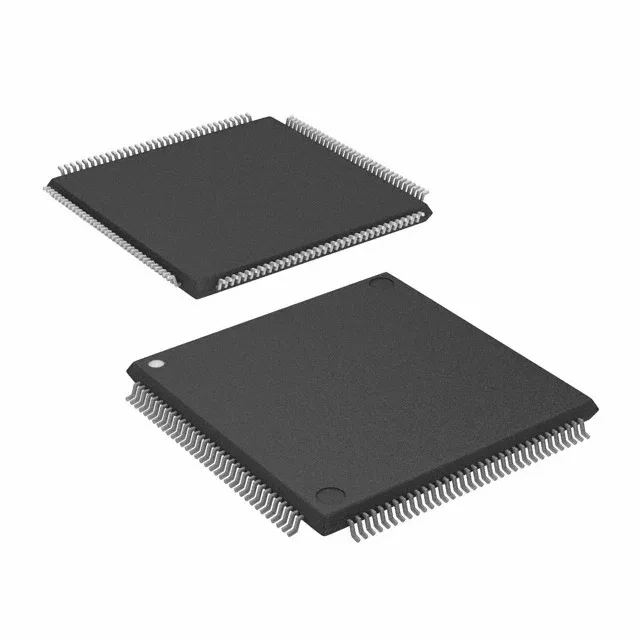
What the TM4C1233H6PGEI7R brings to the board
The Texas Instruments TM4C1233H6PGEI7R is a Tiva C Series ARM Cortex-M4F microcontroller running at 80 MHz. The 105 GPIOs in a 144-LQFP package mean you can hang a lot of sensors and actuators directly off the pins without needing port expanders.
The floating-point unit on the Cortex-M4F core handles single-precision math in hardware. For a motor-control loop or a sensor-fusion algorithm that cycles through trig and matrix operations, that saves dozens of cycles per call versus software emulation. At 80 MHz, the core has about 12.5 ns per instruction cycle — enough headroom for a 10 kHz control loop with plenty of margin for communications overhead.
Memory sizing — 256 KB Flash, 32 KB SRAM, 2 KB EEPROM
256 KB of Flash holds a moderate application — a CANopen stack, USB device firmware, and a control algorithm fit without squeezing. The 32 KB SRAM is the tight spot: if you are doing double-buffered graphics or large FFTs, watch your heap and stack budgets. The 2 KB EEPROM is useful for calibration constants and configuration parameters that survive a firmware update, since it is separate from the Flash program space.
Connectivity and analog — CAN, USB, 24-channel 12-bit ADC
The peripheral set includes CANbus, USB, multiple SPI/I²C/UART serial ports, and a 24-channel 12-bit ADC. The brown-out detect and POR keep the core from running wild during supply glitches.
Temperature range and package — field-service reality
The 144-LQFP package is a 20x20 mm body with 0.5 mm pitch — reworkable with a hot-air station if you have a steady hand and a stencil.