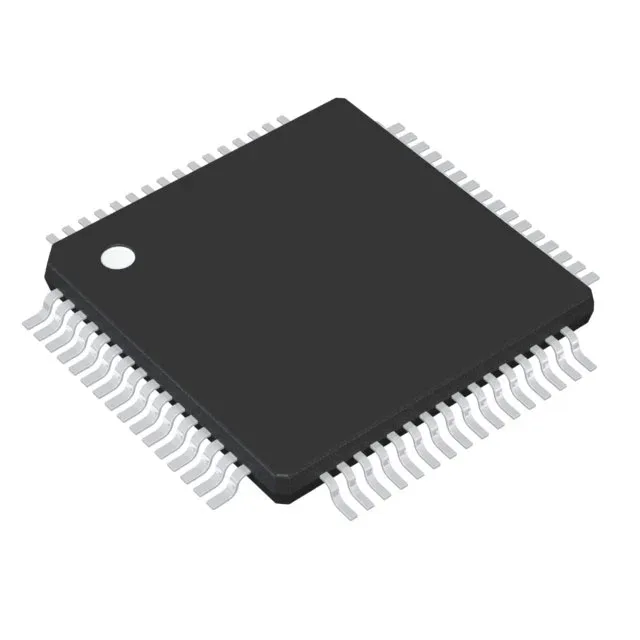
Texas Instruments TM4C1233E6PMI — Microcontrollers & Processors (MCU / MPU / DSP)

TM4C1233E6PMI Tiva C ARM Cortex-M4F MCU, 80 MHz

MPNTM4C1233E6PMI
Active

Texas Instruments Tiva™ C TM4C1233E6PMI, ARM® Cortex®-M4F 32-bit MCU, 80 MHz, 128 KB Flash, 32K x 8 SRAM, 2K x 8 EEPROM, CAN/I2C/SPI/UART/USB, 64-LQFP, -40°C to 85°C.

$11.1000Ref. price · indicative, final on quote
Packaging64-LQFP
RoHSROHS3 Compliant
SeriesTiva™ C
Independent supplier — new & surplus stockAuthenticity-screened · ESD-safe packingListing updated Aug 2026

Specifications

TM4C1233E6PMI specifications
ParameterValue
SeriesTiva™ C
MountingSurface Mount
Oscillator typeInternal
Program memory typeFLASH
Voltage - supply (Vcc (Vdd))1.08V ~ 3.63V
Operating temperature-40°C ~ 85°C (TA)
Speed80MHz
PackageTray
RAM size32K x 8
Core size32-Bit Single-Core
EEPROM size2K x 8
PeripheralsBrown-out Detect/Reset, DMA, POR, WDT
ConnectivityCANbus, I2C, IrDA, Microwire, SPI, SSI, UART/USART, USB
Number of i (O)43
Core processorARM® Cortex®-M4F
Case64-LQFP
Data convertersA/D 12x12b
Program memory size128KB (128K x 8)

Product details

The TM4C1233E6PMI: The core runs at 80 MHz with a hardware FPU. Program memory is 128 KB of Flash, paired with 32 KB SRAM and 2 KB EEPROM for non-volatile parameter storage. On the peripheral side, this part carries CAN, USB, I2C, SPI, SSI, UART/USART, and IrDA — a connectivity set that lets a single MCU handle a motor drive with CANopen, a USB service port, and a sensor bus over I2C or SPI without external bridge chips.

It is not rated for the 125°C junction of automotive under-hood environments; for that, the C2000 Piccolo family (F280041PZQR) covers the AEC-Q100 qualified path. Housed in a 64-LQFP with a 10x10 mm body, the package offers 43 I/O lines and a 12-channel 12-bit ADC. The LQFP footprint is hand-solderable and inspectable, which helps during prototyping and low-volume production runs.

5V logic compatibility note

The I/O pins are not 5V-tolerant at the supply range listed. Interfacing with 5V peripherals requires level translation or open-drain configuration with external pull-ups — something to flag early in the schematic review if the design mates with legacy 5V logic.

Frequently asked questions

What is the maximum operating frequency of TM4C1233E6PMI?

The core runs at 80 MHz. At that speed the Flash requires one wait state for zero-wait execution; the FPU operates at full clock rate.

Can TM4C1233E6PMI replace TM4C123GH6PM?

Both parts share the same 64-LQFP footprint and peripheral set, but the GH6PM carries 256 KB Flash versus 128 KB here. If the firmware fits in 128 KB and the extra SRAM is not needed, the E6PMI is a drop-in replacement. For larger code bases, the GH6PM is the correct fit.

How does TM4C1233E6PMI compare to STM32F103C8T6?

Both are 32-bit ARM Cortex-M3/M4F MCUs in LQFP packages, but the TM4C1233E6PMI runs at 80 MHz (vs 72 MHz on the STM32F103), includes a hardware FPU, and adds CAN and USB. The STM32F103 has a larger ecosystem and lower per-unit cost at volume, but lacks the floating-point unit and CAN interface.