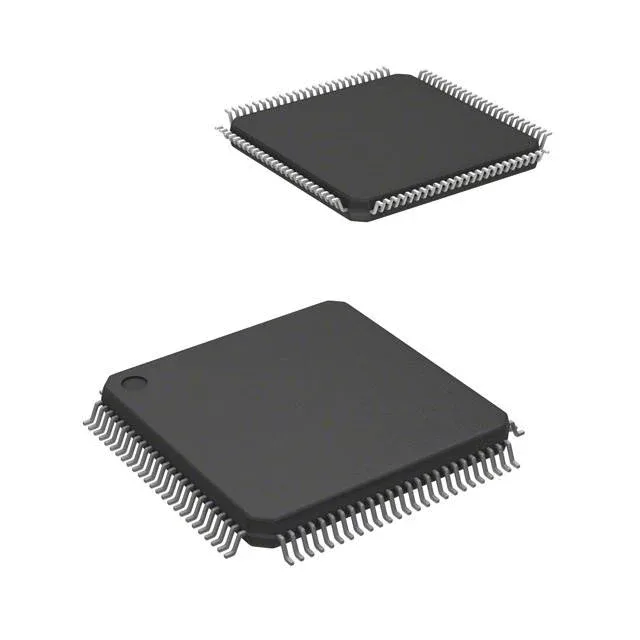
The 100-LQFP package gives you 69 GPIO lines, and the peripheral set includes CAN, USB, multiple UART/SPI/I²C interfaces, plus a 22-channel 12-bit ADC. This is the part you spec for an industrial controller, a motor-drive comms gateway, or a CAN-bus node that also needs a USB programming port.
80 MHz with FPU — what that means on the bench
The Cortex-M4F core at 80 MHz gives you single-cycle MAC and hardware divide, plus the FPU handles single-precision float operations without software emulation. For a control loop that runs a PID on sensor feedback, that means the math finishes in time to close the loop at a higher update rate than a Cortex-M3 at the same clock. The 64 KB Flash is the limiting factor — if your firmware with a real-time OS and a TCP/IP stack pushes past that, you are looking at the higher-density siblings in the Tiva C family.
Supply range 1.08 V to 3.63 V; internal POR and brown-out detect reset the core on rail droop.