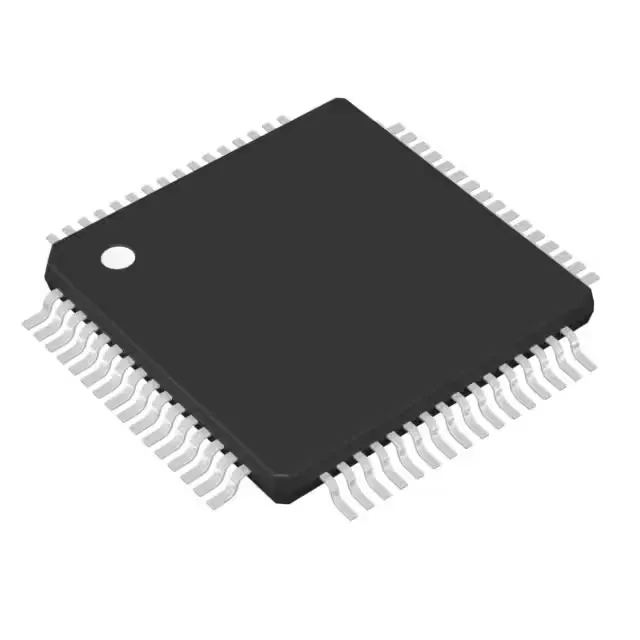
The TM4C1233D5PMIR runs an ARM Cortex-M4F core at 80 MHz with a single-precision floating-point unit. That FPU is the difference between a 32-bit software-emulated divide taking dozens of cycles and a hardware divide in one cycle — relevant for control loops in motor drives, power inverters, and sensor fusion where the math budget is tight. The 80 MHz clock also keeps the flash wait-state penalty manageable: at that speed the prefetch buffer hides most of the latency for sequential code.
64 KB Flash and 24 KB SRAM — sizing the firmware envelope
64 KB of program Flash and 24K x 8 of SRAM define the firmware footprint. For a typical industrial CAN node running a real-time OS, a USB stack, and a control loop, 64 KB is workable but leaves little headroom for over-the-air update staging or extensive lookup tables. The 2K x 8 EEPROM emulation block handles calibration and configuration storage without wearing the Flash. If the firmware grows beyond 64 KB, the pin-compatible TM4C123GH6PM (256 KB Flash) is the natural step up within the same 64-LQFP footprint.
Peripheral mix — CAN, USB, and serial for industrial connectivity
The Tiva C series has broad distribution support, so multi-sourcing through independent channels is straightforward.