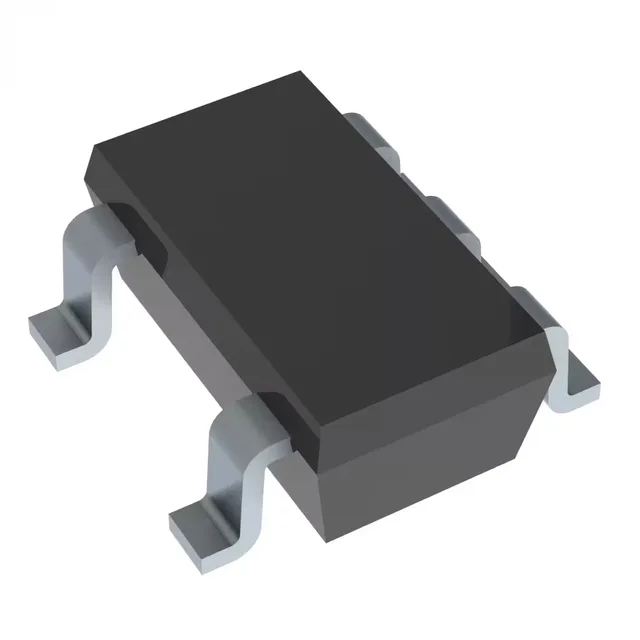
Nanopower op-amp for always-on sensing
Its 450 nA typical supply current and 6 kHz gain-bandwidth product place it squarely in the nanopower class — think battery-backed smoke detectors, IoT sensor nodes, or portable medical monitors where the op-amp stays awake while the rest of the system sleeps. The input bias current of 0.1 pA and input offset voltage of 75 µV are tight enough for precision DC measurement as long as the signal bandwidth stays well below 6 kHz.
A 6 kHz gain-bandwidth product is the first spec to check before dropping this into a design. At a gain of 10, the closed-loop bandwidth is roughly 600 Hz; at a gain of 100, it drops to 60 Hz. That makes the TLV8811DBVR a natural fit for DC-like signals — thermocouple conditioning, strain-gauge bridges, battery voltage monitoring, or photodiode amplifiers where the signal changes slowly. The 0.0015 V/µs slew rate reinforces the same message: this part is not meant for audio, motor-current sense, or any application with fast edges. If your signal needs more than a few hundred Hz of bandwidth, step up to a higher-GBWP sibling like the TLV9351 (3.5 MHz, 20 V/µs) and accept the higher supply current.
450 nA supply — battery-life math
The 450 nA supply current is the headline differentiator. In a 3.7 V Li-ion system with a 500 mAh cell, this op-amp alone draws roughly 4 mAh per year — negligible against self-discharge. That kind of budget lets you leave the amplifier powered continuously for wake-on-signal or threshold detection without a duty-cycling switch. If you need to drive a heavier load (e.g., a 10 mA LED or a long cable), plan for a buffer stage.
The SOT-23-5 package is a five-pin, surface-mount footprint with 0.95 mm pitch, commonly used for single op-amps in space-constrained designs. The SC-74A / SOT-753 case is the same physical outline.