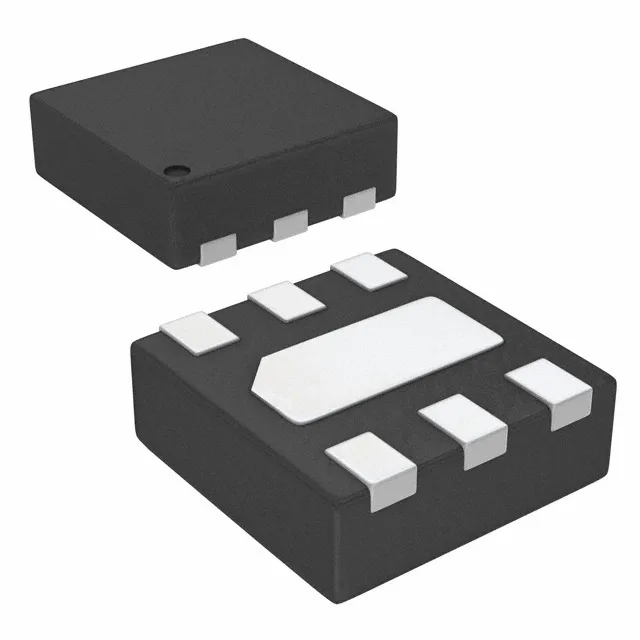
Dual-rail LDO in a 1.2 mm² footprint
The TLV7162818PDPQR is a dual-channel low-dropout regulator from Texas Instruments, delivering two fixed output voltages — 2.8V on one rail and 1.8V on the other — each rated for 150 mA continuous output. The 6-X2SON package measures just 1.2 x 1.2 mm, making it a fit for space-constrained designs like sensor modules, wearable PCBs, or RF front-ends where two separate supply rails are needed from a single 5.5 V max input.
PSRR profile and what it means for noise-sensitive rails
Power-supply rejection ratio is specified at 80 dB at 100 Hz, rolling off to 46 dB at 10 kHz. That 80 dB at line frequency means the regulator attenuates 100 Hz ripple — from a mains-derived rectifier or a switching pre-regulator — by a factor of 10,000, so a 10 mVpp ripple on the input becomes roughly 1 µVpp on the output. The roll-off to 46 dB at 10 kHz still gives 200× attenuation for switching noise in that band, which is relevant when the LDO follows a buck converter switching at 1–2 MHz and its harmonics land in the 10 kHz region.
Protection set and quiescent draw
The part integrates over-current, over-temperature, reverse polarity, short-circuit, and under-voltage lockout (UVLO) protection — a full guard band for a dual-rail supply feeding an MCU and its analog front-end. Quiescent current is 75 µA typical, which keeps the regulator's own draw low enough for battery-powered designs that spend most of their time in a light-load state. The enable pin lets a system controller gate each rail independently, pulling the output to zero when the load is asleep.
Temperature range and package integration
The 6-XFDFN exposed-pad package (X2SON, 1.2 x 1.2 mm) requires a thermal via under the pad to the ground plane for heat spreading — without it, the thermal resistance rises and the output current may need derating above 85°C ambient. The 0.4 mm pitch demands careful solder-paste stencil design; a 0.2 mm aperture reduction on the inner pads prevents bridging during reflow.