350 nA supply — the battery-life decision
The TLV521DCKT: Drawing just 350 nA from a 1.7 V to 5.5 V supply, this op-amp's quiescent current sits below the self-discharge rate of many coin cells. For a sensor node that sleeps 99 % of the time and wakes to amplify a microvolt-level signal, the TLV521's own draw does not shorten the battery life — the leakage of the blocking capacitor matters more. The 6 kHz gain-bandwidth product and 0.0025 V/µs slew rate tell you this is a DC-to-slow-signal part — think thermocouple conditioning, strain-gauge bridges, or electrochemical sensor front-ends. It is not meant for audio or switching applications; the 12 mA output drive is enough to swing a microcontroller ADC input rail-to-rail. Input bias current is 1 pA typical, and input offset voltage is 100 µV — both well within the range for precision DC measurements without needing a chopper-stabilized topology. The -40 °C to 125 °C operating range covers automotive under-hood and industrial enclosure environments.
SC-70-5 package — field-swap reality
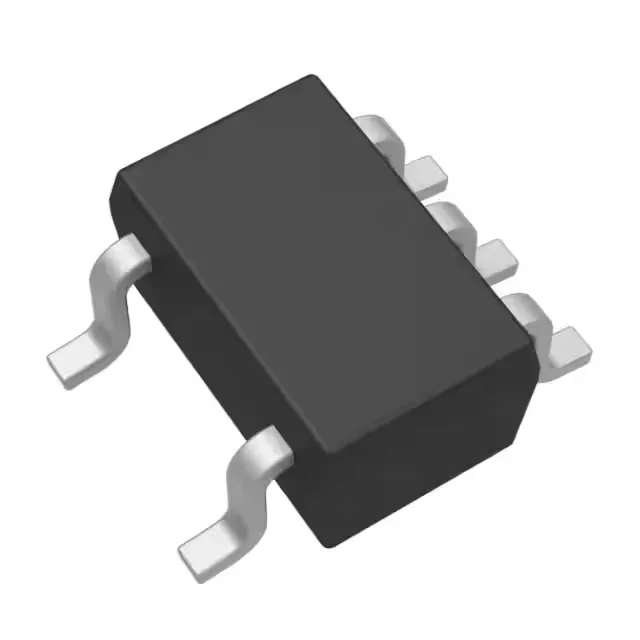
The SC-70-5 (SOT-353) footprint is a common 5-pin package — 2.0 mm × 1.25 mm body, 0.65 mm pitch. It is small enough for compact sensor modules but still hand-solderable with a fine-tip iron and magnification. No hot-air station required for a field swap if the board has accessible pads. Surface-mount only, supplied in Tape & Reel or Cut Tape options. The single-circuit (1 channel) CMOS amplifier means one device per package — no shared channels to worry about in layout.
Compliance and sourcing posture
RoHS3 compliant (2011/65/EU + 2015/863) with no exemptions — no lead, cadmium, or phthalates above the threshold.