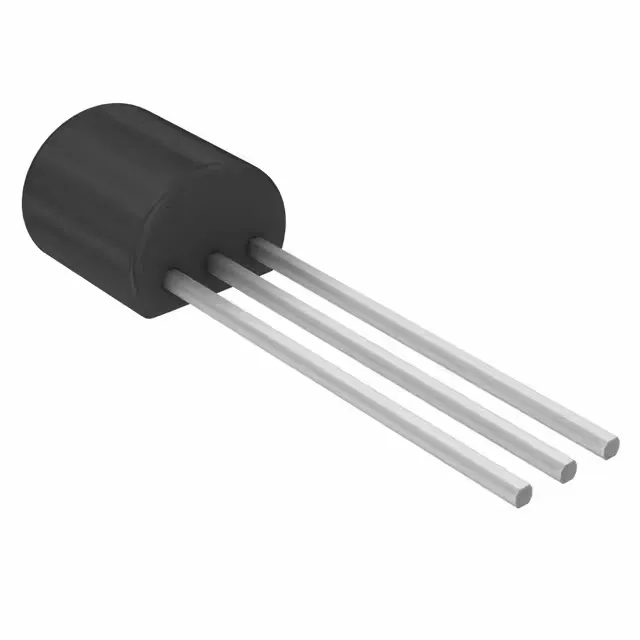
±0.5% shunt reference in a TO-92 body
It delivers a reference voltage adjustable from 1.24 V up to 6 V with a guaranteed tolerance of ±0.5% — tight enough for most low-cost power supply feedback loops and bias circuits. The shunt topology means it behaves like a programmable Zener: you set the output voltage with two external resistors, and the part sinks current from the cathode to ground to regulate. Maximum cathode current is 15 mA, with a minimum operating current of 100 µA. Packaged in a through-hole TO-92-3 body, it is a direct fit for breadboards, prototype runs, and rework — no hot-air or reflow profile needed. The base product number is TLV431, so the datasheet and application notes for the family apply directly.
The ±0.5% tolerance is the initial accuracy at 25 °C. For a 2.5 V set point, that is ±12.5 mV — acceptable for a generic bias rail or a comparator threshold, but not for a precision ADC reference without trimming. If you need a fixed 2.5 V reference, the TL431 family offers a 2.5 V fixed version, but the TLV431BQLPE3 gives you the flexibility to dial in any voltage in that window with two resistors. The shunt architecture requires a cathode resistor from the supply to the cathode pin. The resistor value is calculated from (V_supply - V_ref) / I_cathode, where I_cathode must stay between 100 µA and 15 mA. This is standard shunt-reference design — nothing exotic, but easy to overlook in a first pass.
This is a through-hole part in a TO-92 package with the same pinout and shunt topology.