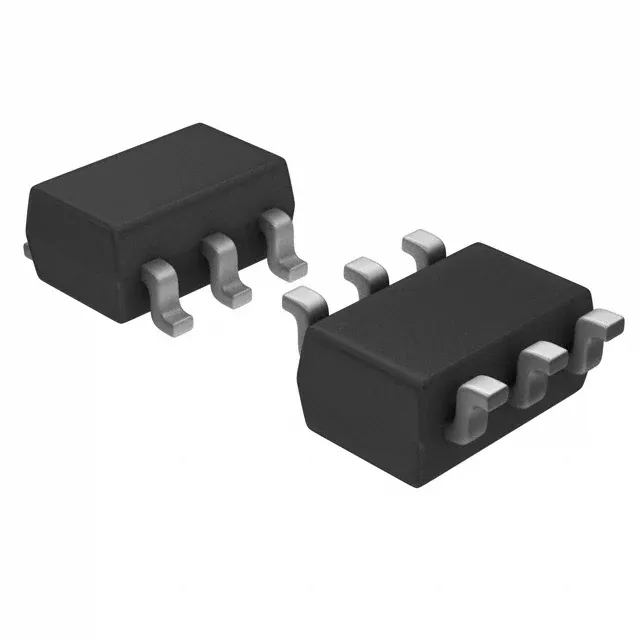
Active production — BOM-fit for always-on threshold monitoring
The Texas Instruments TLV3012AIDBVR is an active-production comparator with an integrated 1.242 V series voltage reference in a SOT-23-6 package. The on-chip reference eliminates the external reference IC and its associated bypass capacitor, saving board area and BOM line count for threshold-setting circuits.
5 µA quiescent — the battery-life anchor for always-on comparators
In a battery-powered sensor node that spends most of its life monitoring a threshold, the comparator's own draw sits below the self-discharge rate of a CR2032 coin cell — the system stays alive for years without a battery change. The push-pull output drives CMOS logic inputs directly — no external pull-up resistor needed.
74 dB CMRR, 80 dB PSRR — noise rejection for threshold accuracy
Typical CMRR of 74 dB and PSRR of 80 dB mean the comparator's switching threshold shifts less than 0.2% per volt of common-mode or supply change. For a 1.242 V reference threshold, a 100 mV supply ripple injects under 0.25 mV of offset — the trip point stays stable even on a noisy 3.3 V rail from a switching regulator. Maximum input offset voltage is 12 mV at 5.5 V. For threshold detection with 10-100 mV of hysteresis (external positive feedback), the offset is negligible. The 10 pA max input bias current allows the use of high-impedance sensor dividers (up to several MΩ) without significant voltage error.
13.5 µs propagation delay — speed class for overcurrent and level sensing
Maximum propagation delay is 13.5 µs. This is fast enough for overcurrent detection in a motor-drive input stage (typical response budget 50-100 µs) and for level translation between voltage domains. It is not suited for MHz switching or high-speed PWM current regulation — those applications need sub-microsecond comparators.
Industrial temperature range and compliance
The SOT-23-6 package keeps the PCB footprint small but limits power dissipation — the 5 µA quiescent current is well within the thermal budget even at 85°C.