160 kHz GBW at 7 µA — the battery-life tradeoff
Its 160 kHz gain-bandwidth product and 0.06 V/µs slew rate limit it to DC and low-frequency signals — think thermocouple amplifiers, photodiode transimpedance stages below a few kilohertz, or level-shifting a 0-10 V sensor output into a 3.3 V ADC. The rail-to-rail output swing lets it drive the full input range of a successive-approximation ADC without an extra reference buffer, and the 400 µA per-channel output current is enough for a reference input or a low-power comparator load.
Input bias current is 1 pA typical, so high-impedance sources like pH probes or piezoelectric sensors see negligible loading.
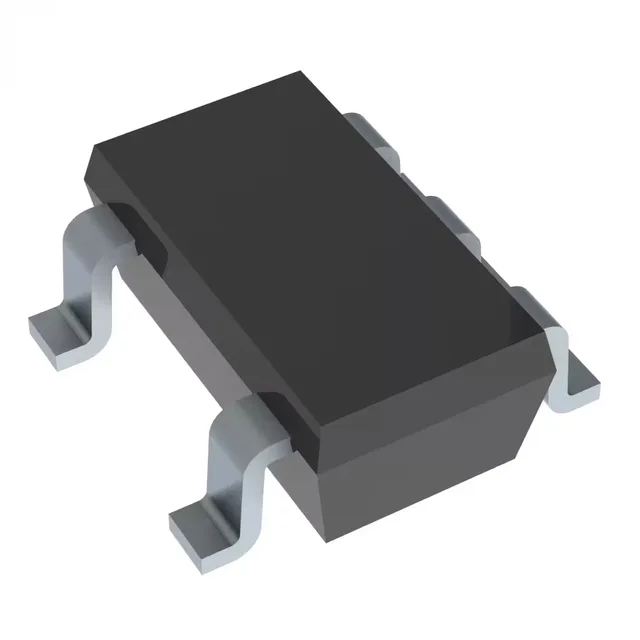
Housed in a 5-pin SOT-23 (SC-74A) package, the same footprint used by hundreds of single op-amps — a drop-in swap for many low-power general-purpose parts without a board spin.