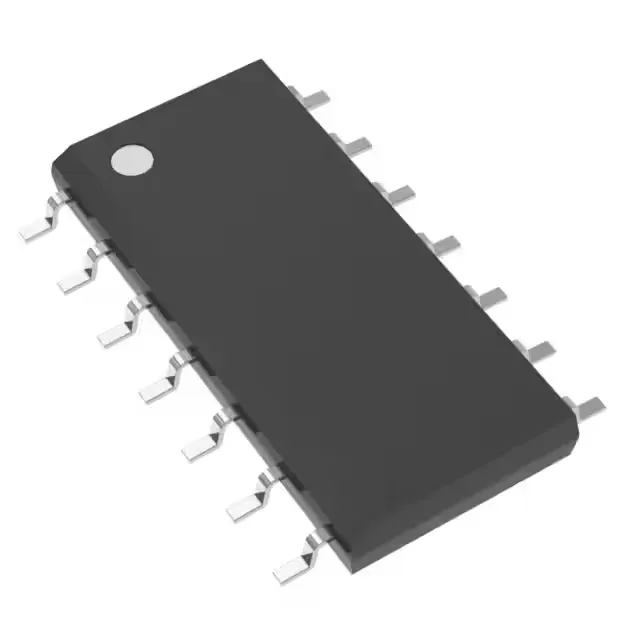
Texas Instruments TLV2774AID — Analog & Data Acquisition

TLV2774AID CMOS Quad Op-Amp, 5.1 MHz, 10.5 V/µs

MPNTLV2774AID
End of Life

Texas Instruments TLV2774AID, quad CMOS rail-to-rail op-amp in 14-SOIC, 5.1 MHz GBW, 10.5 V/µs slew rate, 2.5 V to 5.5 V supply, -40°C to 125°C.

$5.86Ref. price · indicative, final on quote
Packaging14-SOIC (0.154", 3.90mm Width)
RoHSROHS3 Compliant
Independent supplier — new & surplus stockAuthenticity-screened · ESD-safe packingListing updated Aug 2026

Specifications

TLV2774AID specifications
ParameterValue
Output typeRail-to-Rail
MountingSurface Mount
Amplifier typeCMOS
Voltage - input offset700 µV
Voltage - supply span5.5 V
Current - supply1mA (x4 Channels)
Current - input bias2 pA
Current - output (Channel)50 mA
Operating temperature-40°C ~ 125°C (TA)
Gain bandwidth product5.1 MHz
PackageTube
Slew rate10.5V/µs
Case14-SOIC (0.154\", 3.90mm Width)
Number of circuits4

Product details

What this quad CMOS op-amp brings to the board

It delivers a 5.1 MHz gain-bandwidth product and a 10.5 V/µs slew rate from a 2.5 V to 5.5 V supply, drawing 1 mA per channel. Rail-to-rail output swing means the amp can drive an ADC input or a comparator threshold close to the supply rails without an extra rail splitter.

Slew rate is 10.5 V/µs. The OPA4374AIPWT, a pin-compatible alternative, manages 5 V/µs.

Supply current and power budget

Supply current is 1 mA per channel (4 mA total). Output current per channel is 50 mA.

Frequently asked questions

What is a replacement for TLV2774AID?

The OPA4374AIPWT is a functional second-source candidate: same quad CMOS rail-to-rail topology, same 14-SOIC footprint, but with a 5 V/µs slew rate versus 10.5 V/µs. For a direct drop-in with identical slew rate, stick with the TLV2774AID.

What is the difference between TLV2774 and TLV2774A?

The 'A' suffix on TLV2774AID typically indicates an enhanced specification variant — often tighter input offset voltage or wider temperature range. The evidence for this specific part shows a 700 µV input offset and -40°C to 125°C range, consistent with the 'A' grade.