5.1 MHz GBW, 10.5 V/µs slew rate — what these mean on the bench
The TLV2771IDBVR is a single-channel general-purpose op-amp from Texas Instruments with a 5.1 MHz gain-bandwidth product and a 10.5 V/µs slew rate. For a unity-gain buffer, the 5.1 MHz GBW sets the -3 dB closed-loop bandwidth; at a gain of 10, the usable bandwidth drops to roughly 510 kHz. The 10.5 V/µs slew rate means a full 5 V output step settles in about 475 ns before slewing limits the rise time — fast enough for audio processing, sensor conditioning, and moderate-speed ADC drivers. Supply current is 1 mA typical, and the rail-to-rail output stage swings within millivolts of both rails — useful when running from a single 2.5 V to 5.5 V supply and you need every bit of dynamic range. Input bias current is 2 pA, so it won't load a high-impedance source like a pH probe or photodiode front-end.
Industrial temperature grade and SOT-23-5 package
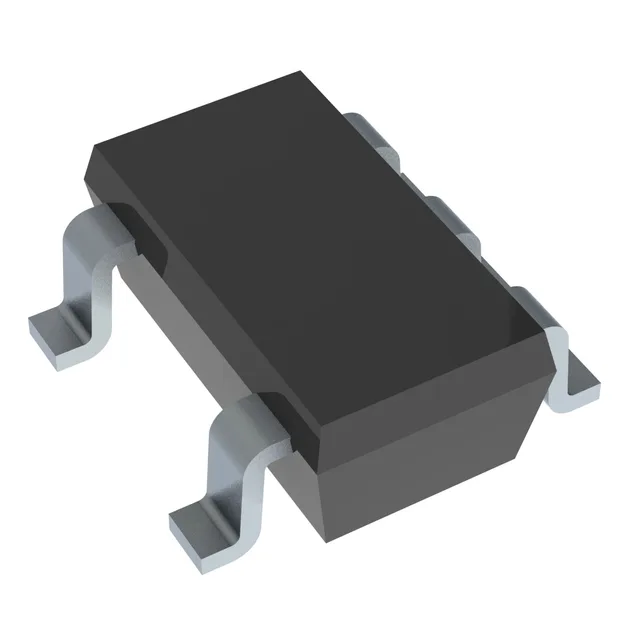
Rated for -40°C to 125°C operation, the TLV2771IDBVR covers the industrial temperature range — suitable for engine-bay electronics, outdoor instrumentation, and factory-floor sensor modules. The SOT-23-5 (SC-74A) package is a compact 5-lead footprint, 2.9 mm × 1.6 mm, with 0.95 mm pin pitch. It reflows on a standard JEDEC profile and fits tight PCB layouts where board area is at a premium. Output can source or sink 50 mA, enough to drive a small relay coil or an LED indicator directly. Input offset voltage is 500 µV max — adequate for most general-purpose signal chains without external trimming.