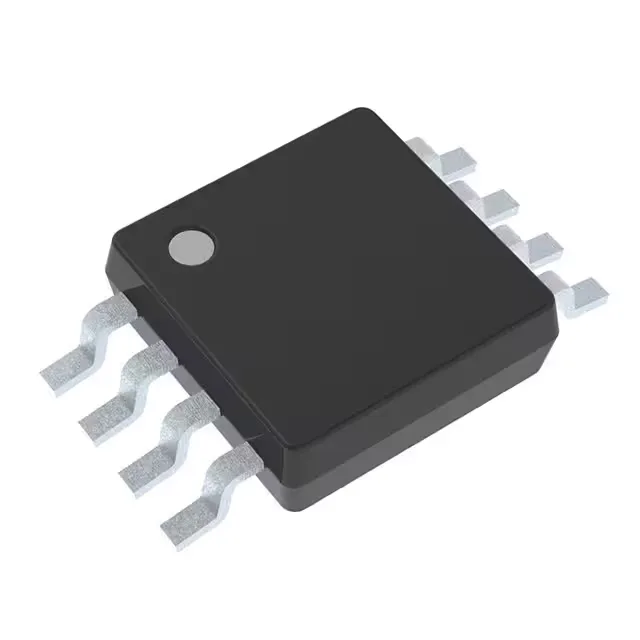
Automotive-grade CMOS op-amp for sensor conditioning and actuator drive
The CMOS input stage draws only 1 mA quiescent supply current and presents 2 pA input bias current, making it suitable for high-impedance sensor interfaces in engine control units, transmission modules, and body electronics.
With a 5.1 MHz gain-bandwidth product and 10.5 V/µs slew rate, this op-amp can handle moderate-speed sensor signals up to several hundred kilohertz without significant distortion. The 50 mA output current capability allows direct drive of small inductive loads such as relays or solenoids in automotive actuator circuits.
Supply voltage and quiescent current — power budget fit
The 1 mA typical supply current is low enough for always-on sensor modules in battery-backed systems, yet the output can deliver 50 mA when needed. This combination suits designs where a single op-amp must both condition a sensor signal and drive a downstream load without a separate buffer.
Package and footprint — 8-VSSOP (3.00 mm width)
Housed in an 8-VSSOP package (also described as 8-TSSOP or 8-MSOP with 0.118-inch, 3.00 mm body width), the TLV2770IDGK occupies minimal board area. The surface-mount footprint is compatible with standard reflow processes. The supplier device package is 8-VSSOP, which is the same mechanical outline as the 8-MSOP. No special thermal management is required at the 1 mA quiescent current level.
Lifecycle and compliance — active, RoHS non-compliant
However, it is listed as RoHS non-compliant. This is a sourcing constraint for designs that must meet EU RoHS or similar regulations. For RoHS-compliant requirements, verify whether an exemption applies or evaluate a lead-free alternative such as the TLV2770IDGKR (if available). The AEC-Q100 qualification is retained across the family.
Sourcing and availability — quoted to order
Given the active lifecycle status, there is no imminent supply risk for production builds. For dual-sourcing or second-source evaluation, the TLV9351IDCKR is a functionally similar single CMOS op-amp with a 3.5 MHz GBW and 20 V/µs slew rate, but it is not a direct pin-for-pin replacement — verify the pinout and package compatibility before substituting.