The rail-to-rail output stage maximizes dynamic range on low-voltage supplies, and the 730 µA quiescent current keeps the power budget manageable in battery-powered or thermally constrained designs.
The 9 MHz gain-bandwidth product sets the usable closed-loop bandwidth: at a gain of 10, the -3 dB point lands near 900 kHz. The 10 V/µs slew rate handles 2 Vpp signals up to roughly 800 kHz without slew-induced distortion, so the part can drive the input of a 12-bit SAR ADC sampling at 1 MSPS without settling-time issues. Input bias current is 1 pA typical, which keeps offset drift negligible when the source impedance is in the tens of kΩ range.
The 5.5 V maximum covers 5 V ±10% systems. The rail-to-rail output is a real advantage when the supply is 3.3 V and you need the signal to swing within 100 mV of each rail.
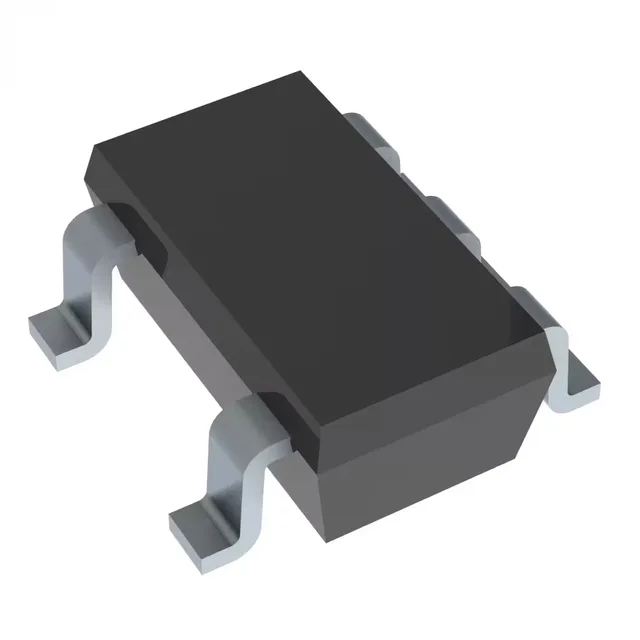
Housed in a 5-pin SOT-23 (SC-74A), the TLV2631IDBVT takes up minimal board area and is a drop-in for many single-op-amp footprints. The part is ROHS3 compliant.