6.4 MHz GBW, 1.6 V/µs slew — what the numbers mean on the bench
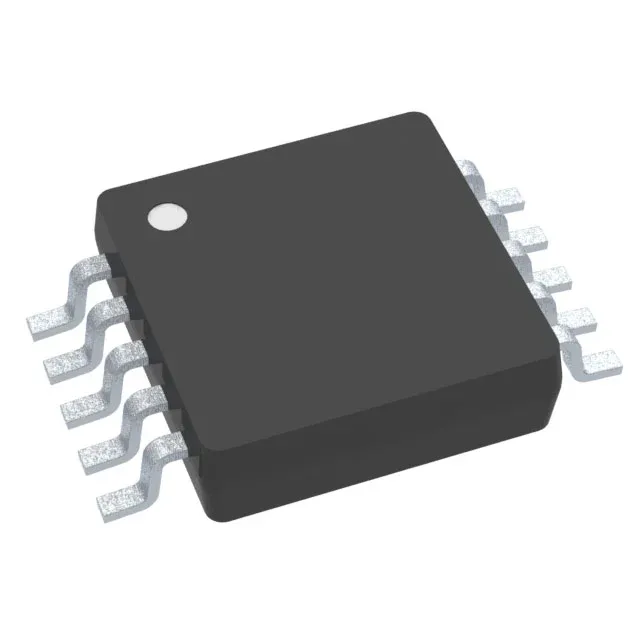
The TLV2463IDGSR is a dual general-purpose op-amp from Texas Instruments, packing two independent amplifiers in a 10-VSSOP package. The 6.4 MHz gain-bandwidth product means it can handle signals up to about 640 kHz at a gain of 10 before the open-loop gain drops by 3 dB — useful for audio processing, sensor conditioning, or active filter stages that don't need a video-speed amplifier. The 1.6 V/µs slew rate sets the large-signal bandwidth ceiling: at a 5 V output swing, the output can transition in about 3.1 µs, which corresponds to a full-power bandwidth of roughly 100 kHz. Below that frequency, the output follows the input without distortion; push above it and the output starts slewing, introducing nonlinearity. The input common-mode range also extends to the rails, so it works as a unity-gain buffer or a non-inverting stage without losing range at the extremes.
Each channel draws 550 µA supply current, so the dual part consumes about 1.1 mA total quiescent — low enough for battery-powered instrumentation or loop-powered transmitters where every milliamp is budgeted. The 80 mA output current per channel can drive moderate loads like a headphone amplifier or an ADC reference buffer without an external booster. The 2.7 V to 6 V supply span covers single lithium-ion cells (3.0-4.2 V) through regulated 5 V rails, and the 1.3 nA input bias current keeps errors low when interfacing high-impedance sensors like pH probes or piezoelectric accelerometers. The 10-VSSOP (also called 10-MSOP with 0.118-inch / 3.00 mm body width) is a compact surface-mount package. The 0.5 mm pin pitch demands careful PCB layout — route the supply decoupling caps close to the pins, and keep the feedback network tight to the inverting input to minimise parasitic capacitance that could eat into the phase margin at higher gains.