Quad op-amp for battery-powered sensor conditioning
The TLV2454IDR is a quad-channel general-purpose operational amplifier from Texas Instruments, designed for low-power signal conditioning in portable and industrial applications. With a gain-bandwidth product of 220 kHz and a slew rate of 0.11 V/µs, it handles slow-moving sensor signals — thermocouple outputs, photodiode current-to-voltage stages, or battery-monitoring dividers — where the bandwidth ceiling is below 20 kHz and the signal amplitude stays under a few volts. Each channel draws 23 µA of supply current, keeping the total quiescent draw under 100 µA for the quad package — a meaningful advantage in a 2.7 V to 6 V system where every microamp extends battery life between charges.
Supply range, output swing, and temperature grade
The rail-to-rail output stage swings within millivolts of both supply rails, preserving dynamic range when running from a 3.3 V or 5 V single supply — no negative rail needed for ground-referenced signals. Operating temperature spans -40°C to 125°C, covering industrial enclosures, automotive cabin electronics, and outdoor telecom gear where ambient heat or cold-soak is a given. Input offset voltage is 300 µV typical, and input bias current is 500 pA — adequate for DC-coupled bridge sensors or pH probes where the offset error stays within the ADC's least-significant bit budget.
Package, footprint, and assembly
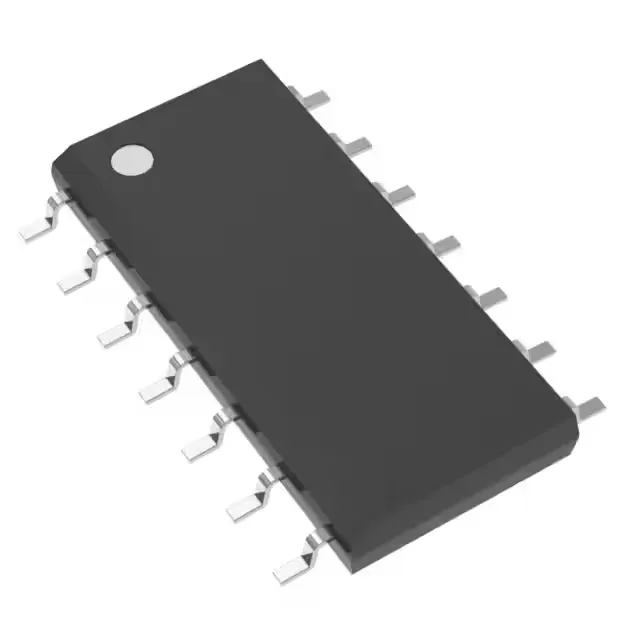
Housed in a 14-SOIC package (3.90 mm body width), the TLV2454IDR mounts on the same land pattern as standard SOIC-8 but with four extra pins for the additional amplifier channels — a direct drop-in for existing quad-op-amp layouts on two-layer boards. Supplied on tape and reel (TR) or cut tape (CT) — the reel format suits high-volume pick-and-place; cut tape works for prototype runs or small-batch builds. Each channel can source or sink 10 mA, enough to drive the input of a successive-approximation ADC or a low-impedance reference buffer without an external booster stage.
Lifecycle and compliance
RoHS3 compliant — no restricted substances above the threshold; the part ships without a halogenated flame retardant or lead in the solder finish.