Rail-to-rail output in an 8-pin DIP — why it matters for the BOM
The 3 MHz gain-bandwidth product and 2.1 V/µs slew rate are enough for audio-frequency filtering, sensor conditioning, and control-loop compensation in industrial and automotive environments rated -40°C to 125°C.
With a 3 MHz gain-bandwidth product, the TLV2372IPG4 delivers a closed-loop bandwidth of 300 kHz at a gain of 10, or 30 kHz at a gain of 100 — sufficient for most sensor and audio paths. The 2.1 V/µs slew rate supports a full 8 V peak-to-peak output swing up to about 42 kHz without slew-rate limiting; above that, the output risetime begins to distort fast edges. The 1 pA input bias current is critical for high-impedance sources like photodiodes or pH probes, where even nanoamps of bias would create a measurable offset across the source resistance.
The 2.7 V to 16 V supply span means this op-amp works from a single lithium cell (3.0 V) up to a 12 V industrial bus. Each channel draws 750 µA quiescent supply current, keeping the total for both amplifiers at 1.5 mA — a reasonable budget for battery-powered or thermally constrained boards. The 2 mV typical input offset voltage is adequate for general-purpose signal chains; precision applications below 1 mV may need a chopper-stabilised alternative.
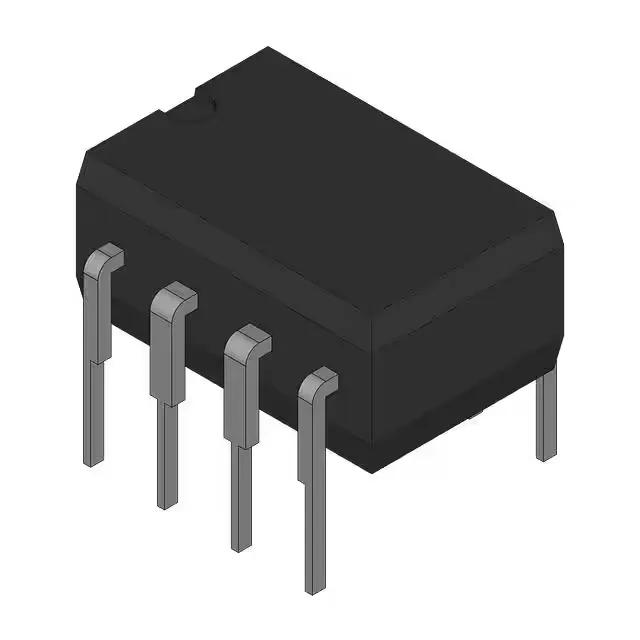
The 8-PDIP package is a through-hole format, which simplifies hand-assembly and rework but occupies more board area than a surface-mount SOIC-8. For BOM planning, the base product number TLV2372 covers multiple package and temperature variants; the IPG4 suffix pins down the 8-PDIP, -40°C to 125°C grade.