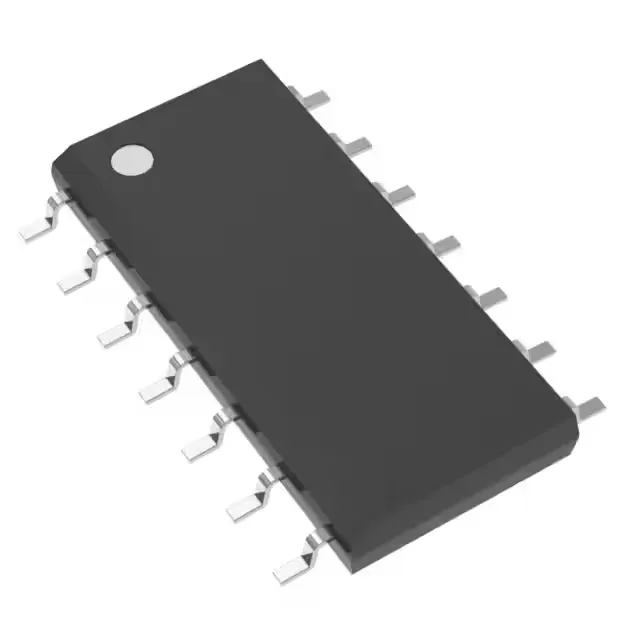
Package and board integration
The TLV2264IDR comes in a 14-SOIC package (0.154" body width, 3.90 mm), a standard footprint that hand-solders cleanly with a fine-tip iron or hot-air station — no reflow oven required for prototype runs. Supplier device package is 14-SOIC; the 1.27 mm pin pitch gives enough room for manual routing on a two-layer board without vias under the body.
What the key ratings mean for your signal chain
Four CMOS amplifier channels in one 14-SOIC — the 710 kHz gain-bandwidth product handles audio-band filtering, sensor conditioning, and low-speed data acquisition without breaking a sweat. Rail-to-rail output swing means the op-amp can drive its output within millivolts of the supply rails — useful when running from a 3.3 V or 5 V single supply and you need the full ADC input range. Slew rate of 0.55 V/µs limits the large-signal bandwidth — expect about 8.7 kHz full-power bandwidth at 5 V output swing, so keep fast edges for the small-signal path. Input bias current of 50 pA (typical) lets you use high-impedance sensors like pH probes or photodiodes without adding a separate buffer stage. Supply span from 2.7 V to 8 V covers single lithium-ion, 3.3 V logic rails, and 5 V industrial supplies — no extra regulator needed if your rail falls in that window.
Temperature grade and operating environment
Rated for -40°C to +125°C ambient — this is the industrial temperature band, suitable for outdoor telecom cabinets, engine-bay-adjacent electronics, and factory-floor sensor modules. Each channel draws 1.5 mA supply current (total 6 mA for the quad), keeping the self-heating low enough that the 125°C limit is driven by ambient, not die temperature.
Sourcing and lifecycle reality
ROHS3 compliant — no exemptions for lead in solder or any of the six restricted substances, so it ships into EU and UK markets without a RoHS waiver. Available in Tape & Reel (TR) or Cut Tape (CT) — the CT option is handy for prototype quantities without committing to a full reel.